
If you walked into a health clinic today, could you tell the difference between a practitioner with a four year Bachelor of Health Science and someone who simply finished a weekend online course? In Australia, the title of naturopath isn’t currently a government protected term under AHPRA, which puts the weight of vetting entirely on your shoulders. It’s a heavy burden when you’re already managing a chronic condition and just want to feel better without the fear of dangerous herb-drug interactions.
You likely believe that your health is more than a diagnosis and that natural therapies should complement, not replace, your medical treatments. We understand that finding a safe middle ground feels overwhelming when you’re met with conflicting advice. This guide offers a practical checklist to help you identify degree qualified professionals who prioritise evidence based care. You’ll learn how to verify 2026 accreditation standards and foster a partnership between your GP and natural therapist, ensuring your journey toward balance is both safe and empowering.
Key Takeaways
- Understand how a holistic approach looks beyond your symptoms to support your body’s natural ability to heal and find lasting balance.
- Identify the gold standard for Australian practitioners by ensuring they hold a Bachelor of Health Science for evidence-based, safe care.
- Learn how to find a qualified naturopath using a practical checklist that verifies their professional memberships and clinical standards.
- Prepare for your first deep-dive consultation, where a comprehensive health history helps create a wellness plan tailored to your unique journey.
- Discover how integrative medicine allows natural therapies and conventional treatments to work together safely for your total wellbeing.
What is a Naturopath? Understanding the Holistic Approach in 2026
You might feel like your health is a puzzle with several missing pieces. Perhaps you have managed symptoms for years without ever feeling truly vibrant. A naturopath is a qualified health professional who helps you find those missing pieces by treating you as a whole person, not a list of symptoms. This represents the “More Than Medication” philosophy; it is a recognition that your physical health, emotional state, and environment are all deeply connected. To understand the foundations of this practice, we can look at What is Naturopathy? and how it has evolved into a modern clinical discipline.
By 2026, the Australian healthcare landscape has shifted significantly. We see a growing movement away from “one-size-fits-all” treatments. This change aligns with the latest health trends toward bio-individualized care, where your unique genetic makeup and lifestyle dictate your wellness plan. Instead of just suppressing a headache, your practitioner investigates the root cause, whether it stems from hormonal imbalances, gut health, or chronic stress. They empower you to take an active role in your own healing journey.
The Core Principles of Naturopathic Medicine
Modern practice is built on “Primum Non Nocere,” which means “First, Do No Harm.” In a 2026 context, this involves using the most gentle, evidence-based interventions before considering more invasive options. Your naturopath also acts as a supportive teacher, a principle known as “Docere.” They spend time explaining the “why” behind your body’s signals so you feel confident in your choices. While traditional naturopathy relies on age-old wisdom, today’s practitioners in Australia often integrate this with rigorous scientific research and functional testing to ensure your safety and progress.
Naturopathy vs. Conventional Medicine
It is helpful to understand that these practitioners are complementary health professionals rather than medical doctors. While a GP is your first port of call for acute care or emergencies, a holistic consultation offers a different pace. You can expect an initial session to last between 60 and 90 minutes. This time allows for a deep dive into your sleep patterns, digestion, and mental wellbeing. These professionals often work alongside your medical team, sometimes incorporating physical therapies like remedial massage to release physical tension and support recovery. This collaborative approach ensures you receive the most comprehensive care possible for your long-term health.
Qualifications and Standards: Navigating the Australian Landscape
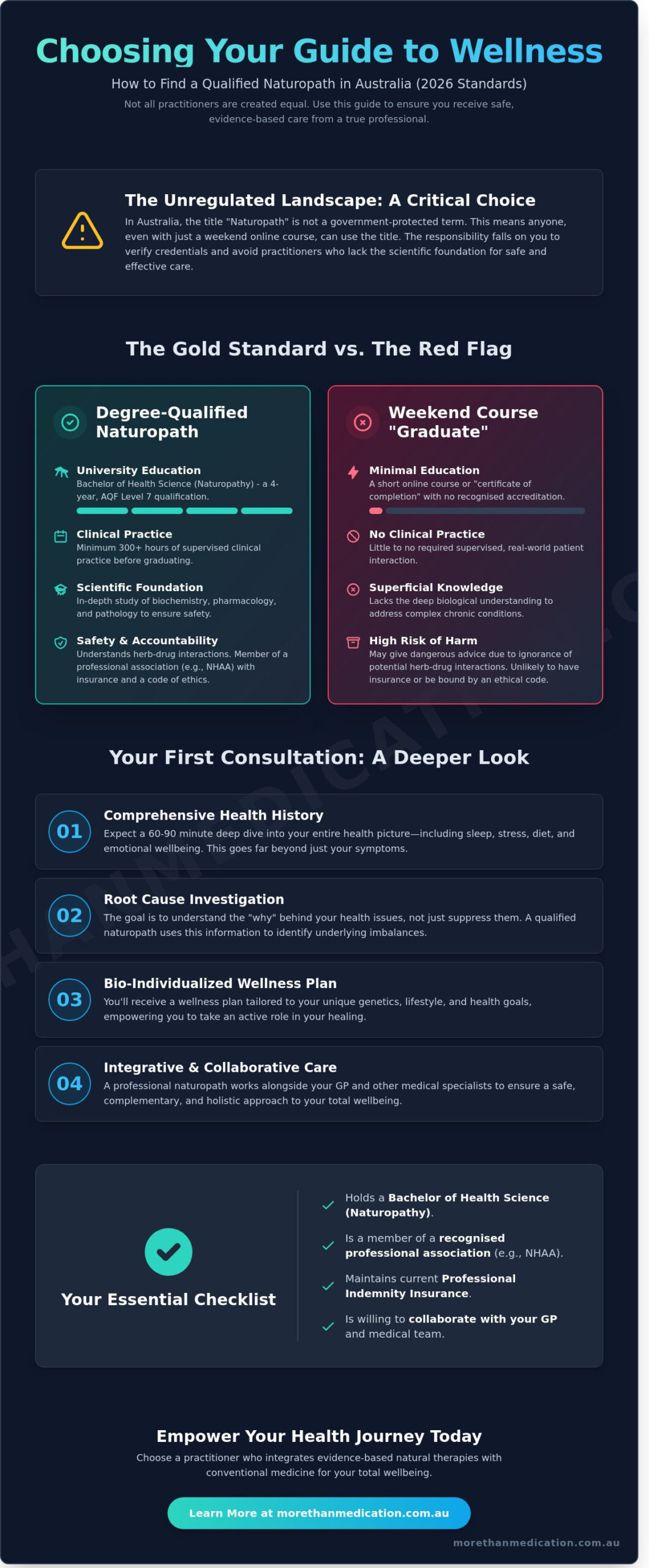
You deserve to feel confident in your care. In Australia, as of 2026, the naturopathy profession remains self-regulated. This means there’s no national law stopping someone from calling themselves a naturopath even if they’ve only completed a weekend course. It puts the responsibility on you to check their credentials; this can feel like an extra burden when you’re already managing a complex health journey.
Look for the gold standard: the Bachelor of Health Science (Naturopathy). Avoid anyone who relies on certificates of completion from unaccredited private colleges. These short courses often skip the deep scientific foundation needed to understand how your body functions. Choosing a practitioner with a university degree ensures your health is in the hands of a professional who values clinical evidence as much as holistic tradition.
Why Education Matters for Your Safety
A qualified practitioner spends over 300 hours in supervised clinical practice before they ever see a patient alone. They study biochemistry and pharmacology to ensure your supplements don’t clash with your GP’s prescriptions. The importance of professional knowledge is paramount; while these therapies are generally safe, they must be managed by someone who understands drug interactions. The Australian Bachelor of Health Science (Naturopathy) is a 4-year AQF Level 7 qualification. This academic rigor protects you from the risks of superficial treatments, replacing them with a nuanced understanding of your unique biology.
The Role of Professional Associations
Since the government doesn’t register practitioners yet, associations like the Naturopaths & Herbalists Association of Australia (NHAA) step in. They act as a protective shield for you. They verify that a practitioner has professional indemnity insurance and follows a strict code of ethics. In 2026, members must complete at least 20 hours of Continuing Professional Development (CPD) annually to keep their skills sharp. Most associations offer “Find a Practitioner” tools on their websites, making it easier to locate a verified naturopath in your local area.
Before booking your first appointment, check for these markers of quality:
- A Bachelor of Health Science (Naturopathy) degree from a recognized institution.
- Current membership with a professional body like the NHAA or ANTA.
- Willingness to share their provider number for private health insurance rebates.
This search is about finding a partner who recognizes that health is More Than Medication and is committed to your long-term resilience. Taking the time to verify these details now ensures your path to wellness is built on a foundation of safety and mutual respect.
The Consultation Process: What to Expect from Your First Visit
Walking into your first appointment might feel like a mix of hope and uncertainty. We understand that sharing your health story requires vulnerability, especially if you’ve felt dismissed in the past. Unlike a standard ten-minute GP visit, your initial consultation with a qualified naturopath is a dedicated space for your narrative. You’ll usually spend between 60 and 90 minutes mapping out your health journey in detail.
The process generally follows four distinct steps to ensure no stone is left unturned:
- Step 1: The Health History. Your practitioner explores everything from sleep patterns and digestion to emotional stressors and family history. It’s about finding the “why” behind your symptoms.
- Step 2: Physical Examination. Expect a check of your blood pressure. Your practitioner may also use traditional diagnostic tools like tongue, nail, and pulse analysis. These methods, often taught through the Naturopaths & Herbalists Association of Australia, offer subtle clues about nutrient absorption or systemic imbalances.
- Step 3: Pathology Review. They’ll review your recent blood tests from a “functional” perspective, looking for optimal ranges rather than just the absence of disease.
- Step 4: Collaborative Planning. You’ll leave with a clear roadmap. This isn’t a lecture; it’s a partnership where your goals dictate the pace of treatment.
The Naturopathic Toolkit: Diet, Herbs, and Lifestyle
Nutritional medicine goes beyond basic advice to eat more vegetables. It involves using specific foods or high-quality supplements at therapeutic doses to correct proven deficiencies. Your practitioner might also prescribe Western Herbal Medicine. These liquid tinctures or tablets are formulated specifically for your needs. Safety is the priority here, so they’ll cross-check every herb against your current medications to prevent interactions. Occasionally, they might suggest acupuncture as a supportive adjunct to help balance your nervous system while the nutritional changes take effect.
Functional Testing and Modern Diagnostics
Modern practitioners often use advanced testing to remove the guesswork from your treatment. You might discuss microbiome mapping to check gut diversity, hormone panels for cycle irregularities, or hair tissue mineral analysis to look for heavy metals. These tests provide a high-resolution picture of your internal environment. It’s vital that these diagnostics complement your GP’s standard blood work rather than replacing it. We encourage you to look at “wellness” tests with a critical eye. A reliable naturopath ensures every test has a clear purpose and provides actionable data for your recovery, ensuring your investment leads to tangible progress.
Integrative Wellness: Using Naturopathy Alongside Conventional Medicine
You might feel a flicker of anxiety when considering natural supplements alongside your prescribed medication. This hesitation is common. You want the best of both worlds without risking your safety. Integrative medicine is the bridge that connects these two paths, ensuring your GP and your naturopath work in harmony rather than in isolation. This partnership acknowledges that while medicine is vital, your health is about the whole person, not just a diagnosis.
For those living with autoimmune conditions, which affect approximately 5% of Australians according to data from the Walter and Eliza Hall Institute, the journey is rarely linear. A naturopath provides a layer of support that looks at the “more” in your health. They focus on gut health, stress management, and nutrient deficiencies that often accompany long-term pharmaceutical use. This helps you build the resilience needed to manage chronic symptoms while your doctor monitors your clinical markers.
Talking to your doctor about natural therapies doesn’t have to be daunting. Most GPs appreciate transparency because it allows them to provide safer care. Try using this simple script during your next appointment:
“I’m working with a qualified naturopath to support my energy and gut health. I’d like to share my treatment plan with you to ensure everything aligns with my current medications and our long-term goals.”
Managing Herb-Drug Interactions
Safety is the foundation of any professional practice. Some natural substances can alter how your body processes medicine. For example, St John’s Wort is known to interact with many common pharmaceuticals, including some antidepressants and blood thinners. A qualified practitioner will always request a full list of your current medications during your initial consultation. Your health is a collaborative effort; a professional naturopath will never advise you to stop prescribed medication without a direct consultation with your GP.
Building Your Healthcare Team
Your health journey is personal, but you don’t have to walk it alone. A multi-modality approach creates a safety net for your physical and mental wellbeing. When you share your naturopathic plan with your medical clinic, you invite an open, non-judgmental dialogue. This transparency reduces risks and empowers your providers to support you as a whole person. It’s about creating a circle of care where every practitioner understands your unique needs.
Learn how to build a balanced healthcare team that supports your unique journey toward wellness.
Choosing the Right Practitioner: Your Essential Selection Checklist
Finding a partner for your health journey is a deeply personal decision. You deserve a naturopath who respects your medical history while offering a path toward holistic balance. Use this checklist to ensure your practitioner meets the high standards required for safe, effective care in Australia.
- Bachelor-level qualification: Verify they hold a Bachelor of Health Science (Naturopathy). This four-year degree is the current gold standard in Australia, ensuring they have studied anatomy, physiology, and pharmacology in depth.
- Professional association membership: Confirm they belong to a recognized body like the Naturopaths & Herbalists Association of Australia (NHAA) or the Australian Natural Therapists Association (ANTA). Membership requires valid professional indemnity insurance and annual continuing professional development.
- Transparent pricing: A trustworthy practitioner provides clear costs upfront. This includes the initial consultation fee, which often ranges from A$120 to A$250 in Australian clinics, and an estimate for any prescribed supplements or functional testing.
- Evidence-based integration: Your practitioner should request your recent blood tests or medical reports. They must prioritize your safety by checking for potential interactions between herbal remedies and your current pharmaceutical medications.
- A professional clinical environment: Whether you meet in a physical clinic or via a secure Telehealth platform, the space should feel private, secure, and dedicated to your care. To learn more about how modern aesthetic and wellness clinics optimize their digital patient experience, check out Digital Med Spa.
Taking the time to verify these details isn’t being difficult; it’s an act of self-care. It ensures that the person you’re trusting with your wellbeing has the clinical rigor to support you safely. When you find the right match, you’ll feel a sense of relief, knowing your health is in capable, compassionate hands.
While these steps focus on the Australian system, finding specialized support for complex insurance plans is a universal need; for those seeking expert guidance on Medicare options, you can discover The Modern Medicare Agency to see how an independent brokerage can simplify your coverage decisions.
Red Flags to Watch For
Your safety is the priority. Be wary of anyone promising a “cure” for chronic conditions like autoimmune disease or cancer. This is not only misleading but often violates Australian health advertising regulations. If a practitioner suggests you stop taking life-saving medication or tells you to avoid your GP, it’s a sign they aren’t practicing safe, integrative care. Be cautious if you’re pressured to buy a large volume of supplements during your first visit without a clear diagnostic reason or a staged treatment plan.
Questions to Ask During Your Discovery Call
Many practitioners offer a free 10 or 15 minute chat to see if you’re a good fit. Use this time to feel out their energy and expertise. You might ask: “What is your specific experience in supporting patients with my condition?” and “How do you communicate with my GP or specialist to ensure my care is coordinated?” Finally, ask “What are the typical costs for follow-up appointments and supplements in the first three months?” This transparency helps you plan your path forward without financial stress, keeping the focus on your healing.
Empowering Your Path to Balanced Wellness
Your health journey is a deeply personal experience, and finding the right support shouldn’t feel like an uphill battle. By 2026, the Australian landscape for complementary medicine has shifted toward greater transparency, making it easier to identify practitioners who meet rigorous standards. You now have the knowledge to verify that your naturopath holds a Bachelor of Health Science and maintains active registration with professional bodies like AROH or ANTA. This ensures your care is rooted in evidence and safety.
We believe that medicine is only one piece of your health puzzle. True resilience comes from an integrative approach that respects both clinical expertise and your unique lifestyle needs. Our expert-led content is reviewed for clinical accuracy to ensure you receive the most reliable guidance available. We’re committed to empowering Australians to lead balanced, vibrant lives through information that bridges the gap between medical treatment and daily wellbeing.
Take the next step in your wellness journey with confidence. Download our Holistic Health Practitioner Checklist to help you find a partner who understands your whole story. You’ve got the power to shape your future health, and we’re here to guide you every step of the way.
Frequently Asked Questions
Is a naturopath the same as a nutritionist in Australia?
No, a naturopath and a nutritionist have different educational backgrounds and scopes of practice. While both focus on dietary habits, a naturopath uses a broader range of tools including herbal medicine and lifestyle coaching to support your whole body. In Australia, a qualified practitioner typically completes a four-year Bachelor of Health Science. This allows them to look at the “more” in your health journey, connecting your physical symptoms with your emotional wellbeing.
Can I get a private health insurance rebate for naturopathy in 2026?
You likely won’t receive a private health insurance rebate for naturopathic consultations in 2026. The Australian Government removed 17 natural therapies from the rebate list in April 2019. Although a 2023 review by the Chief Medical Officer examined new evidence for these treatments, the legislative status for most private health policies remains unchanged. It’s always a good idea to check your specific policy for any wellness grants that might offer limited support.
Do I need a referral from my GP to see a naturopath?
You don’t need a referral from your GP to book an appointment with a naturopath in Australia. You’re welcome to contact a clinic directly to start your care. Many practitioners prefer to work alongside your medical doctor to ensure your treatment is integrated and safe. This collaborative approach helps you feel supported from every angle, making your path to wellness feel less like a solo struggle and more like a partnership.
Can naturopaths order blood tests or other medical diagnostics?
Yes, your practitioner can order various pathology and functional tests to get a clearer picture of your health. These might include hormone panels or nutrient deficiency screens to identify why you’re feeling unwell. You should know that these tests aren’t covered by Medicare, so you’ll pay the full cost directly to the pathology lab. Prices for private tests in Australia often start around A$50 and increase based on the complexity of the analysis.
Is naturopathy safe for children and during pregnancy?
Naturopathic care is generally safe for children and during pregnancy when you consult a degree-qualified professional. They use gentle, evidence-based interventions that respect the delicate nature of these life stages. Your practitioner will carefully screen every herb and supplement to ensure they’re appropriate for your specific needs. It’s about finding a balance that supports your body’s natural resilience while keeping you and your little one secure throughout the process.
How much does a typical naturopathic consultation cost in Australia?
You can expect to pay between A$120 and A$250 for an initial consultation, which usually lasts between 60 and 90 minutes. Follow-up appointments are generally shorter and cost between A$80 and A$150 depending on the clinic’s location. These prices reflect the practitioner’s expertise and the time they spend researching your case outside of your session. Remember that the cost of any prescribed herbal tinctures or supplements will be an additional expense.
What is the difference between a naturopath and a homeopath?
The main difference lies in the treatment methods and the philosophy of care. A naturopath uses a wide range of therapies like clinical nutrition and botanical medicine to address the root cause of your health concerns. Homeopathy is a specific system that uses highly diluted substances to trigger the body’s healing response. While some practitioners study both, they’re distinct disciplines with different educational requirements and clinical applications within the Australian healthcare system.
Can a naturopath prescribe pharmaceutical medications?
Naturopaths cannot prescribe pharmaceutical drugs or restricted medications in Australia. Their expertise focuses on natural substances and lifestyle adjustments that support your body’s innate ability to heal. If you’re already taking medication prescribed by your GP, your practitioner will work around those scripts to ensure there are no harmful interactions. They believe health is about more than just a single diagnosis, focusing instead on your long-term vitality and balance.
⚕️ Medical Disclaimer
This content is for informational purposes only and is not a substitute for professional medical advice, diagnosis, or treatment. Always seek the advice of your doctor or other qualified health provider with any questions you may have regarding a medical condition. Never disregard professional medical advice or delay in seeking it because of something you have read on this website.