
What if the bone-deep fatigue you feel isn’t just a sign of a busy life, but your immune system’s way of asking for help? In Australia, more than 1 million people live with a thyroid disorder; yet the path to feeling like yourself again often feels lonely and confusing. If you’re living with hashimotos, you’ve likely experienced the frustration of symptoms that others can’t see and the anxiety of wondering if a single pill is truly enough to fix how you feel. You know that your health is more than just a line on a pathology report.
We’re here to provide the clarity and compassion you need to move from confusion to confidence. You’ll discover the science behind your thyroid journey and practical lifestyle strategies that work alongside your medication to restore your vitality. This guide explores everything from evidence-based nutrition to stress management techniques, giving you a holistic roadmap to manage your symptoms and reclaim your sense of self. It’s time to look beyond the diagnosis and focus on the whole, vibrant person you are meant to be.
Key Takeaways
- Understand how your immune system affects your thyroid “engine room” and why this connection is the foundation of your energy and metabolism.
- Recognise the subtle, invisible symptoms of hashimotos that often go unnoticed, from persistent brain fog to unexpected changes in your mood.
- Learn why standard blood tests might miss the mark and how advocating for comprehensive antibody testing can lead to a more accurate diagnosis.
- Discover how to support your clinical care with a holistic lifestyle, focusing on essential nutrients like selenium and iodine tailored to the Australian environment.
- Shift your perspective from a diagnosis to a journey by learning how to assemble a supportive team of experts to guide your long-term physical and mental wellbeing.
What is Hashimoto’s Disease? Understanding the Autoimmune Connection
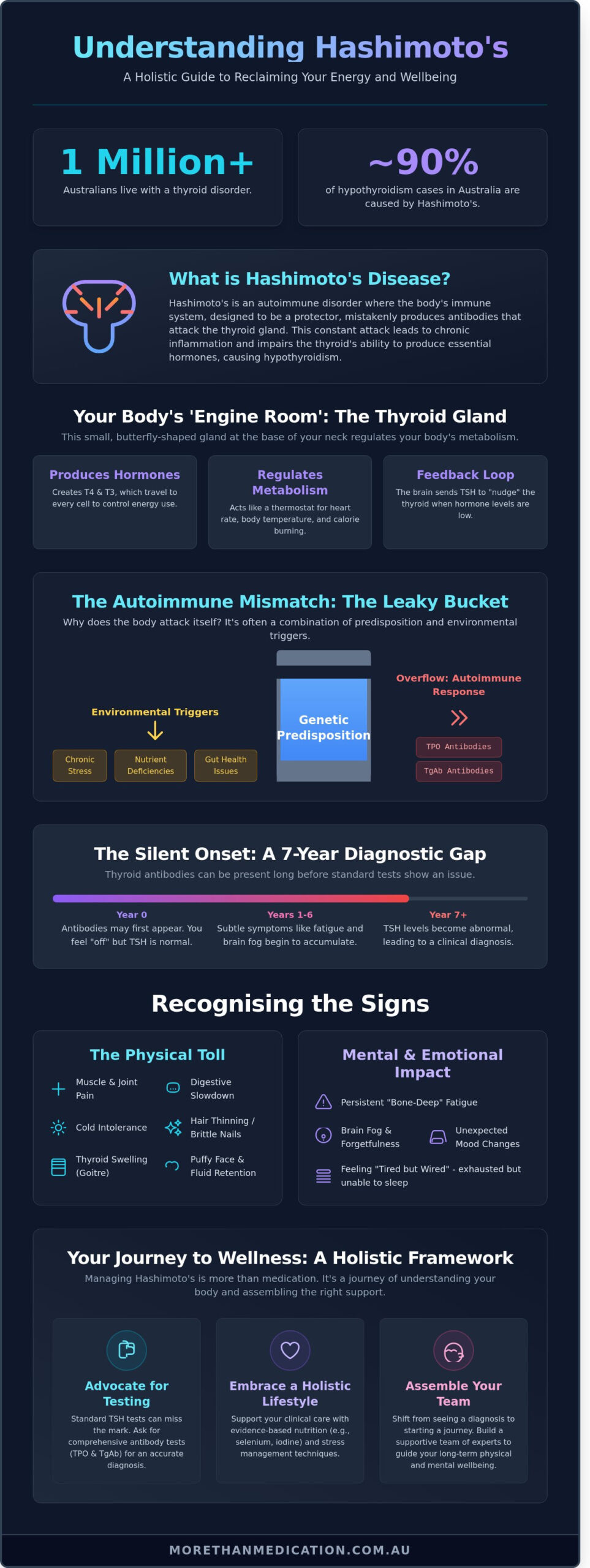
If you’ve been feeling unusually exhausted or noticing your hair thinning, receiving a diagnosis of hashimotos can feel like finally finding a missing puzzle piece. This condition is an autoimmune disorder where your immune system, which is meant to protect you, mistakenly targets your thyroid gland. While hypothyroidism describes the state of having an underactive thyroid, hashimotos is the underlying cause for approximately 90 percent of cases in countries like Australia. This distinction matters because your health is about the whole person, not just a lab result. You’re beginning a journey of discovery, and understanding the why behind your symptoms is the first step toward feeling like yourself again.
The ‘Engine Room’: How Your Thyroid Functions
Your thyroid is a small, butterfly-shaped gland sitting at the base of your neck. Think of it as your body’s engine room. It produces two primary hormones, Thyroxine (T4) and Triiodothyronine (T3), which travel through your bloodstream to reach every single cell. These hormones act like a thermostat, regulating your heart rate, internal temperature, and how quickly you convert food into fuel. When your brain senses a drop in these levels, it releases Thyroid Stimulating Hormone (TSH) to nudge the gland back into action. It’s a delicate feedback loop that keeps your system in balance. When this engine slows down, every process in your body feels the impact, from your digestion to your mental clarity.
The Autoimmune Mismatch: Why the Body Attacks
In an autoimmune response, your immune system produces specific antibodies, such as Thyroid Peroxidase (TPO) and Thyroglobulin (TgAb). These proteins misidentify your thyroid tissue as a foreign threat. Experts often use the leaky bucket analogy to explain how this starts. You might have a genetic predisposition, which represents the bucket, but environmental triggers like chronic stress, nutrient deficiencies, or gut health issues cause the bucket to overflow. According to the Thyroid Foundation, thyroid disorders affect over 1 million Australians, and many of these cases involve this immune mismatch. Remember that this isn’t your fault. It’s a complex biological event. By identifying these triggers, you can move toward a sense of empowerment and resilience as you manage your health journey.
Recognising the Signs: Why Hashimoto’s Often Goes Unnoticed
You don’t wake up one morning suddenly living with hashimotos. It’s a slow, quiet transition that often takes years to fully manifest. Research published in the Journal of Clinical Medicine indicates that thyroid antibodies can be present in your system for 7 years before your TSH levels show any clinical abnormality. This long lead time is why so many Australians feel “off” long before a doctor confirms a diagnosis. You might find yourself reaching for a thick jumper when it’s a mild 22°C outside, or noticing that your morning face looks uncharacteristically puffy in the mirror.
This early stage often brings a confusing “tired but wired” sensation. Your thyroid is under attack, and as cells are destroyed, they can leak excess hormone into your bloodstream. You feel exhausted, yet your heart races and sleep won’t come. It’s a physical contradiction that leaves you feeling misunderstood by your own body. Because these symptoms mirror the effects of a high-pressure job or the demands of parenting, they’re frequently dismissed as “just life.”
The Physical Toll: Beyond Just Fatigue
The impact of hashimotos stretches far beyond simple tiredness. You might notice your hair thinning or your nails becoming brittle enough to snap while doing basic chores. Physical changes often include:
- Muscle and Joint Pain: You may wake up with a stiffness that feels like you ran a marathon, even if you spent the previous day resting. This occurs because low thyroid hormones lead to fluid retention in muscle tissues.
- Digestive Slowdown: Approximately 90% of people with low thyroid function experience chronic constipation. Your gut motility slows down, leading to persistent bloating and a heavy feeling after even small meals.
- Thyroid Swelling: You might notice a fullness at the base of your neck, known as a goitre. It can make shirt collars feel tight or cause a slight difficulty when swallowing.
The Mental and Emotional Impact
The emotional weight of this condition is often the hardest part to carry. Brain fog is a common complaint, but that term doesn’t quite capture the reality. It’s the frustration of losing your car keys for the third time this week or forgetting a close friend’s name mid-sentence. Your processing speed slows down, making daily productivity feel like a mountain climb.
Low thyroid hormones directly affect serotonin and dopamine levels in the brain. This chemical shift can lead to clinical depression or a persistent sense of anxiety that doesn’t have an obvious trigger. You might feel like a shadow of your former self, mourning the energy and clarity you used to take for granted. Validating these feelings is a vital part of your holistic health journey, as your mental wellbeing is just as important as your hormone levels. Recognising that these shifts are biological, not personal failings, is the first step toward regaining control.
The Path to Diagnosis and Navigating Common Misconceptions
You might have spent months feeling like your body is running on a low battery, only to be told your blood results are fine. This experience is incredibly common in the Australian healthcare system, where standard screenings often miss the nuances of hashimotos. A diagnosis should feel like a doorway to answers, not a dead end. To get there, we need to look beyond a single number and understand how your thyroid actually functions in your daily life.
The standard TSH test measures the messenger, not the message. If your brain is shouting at your thyroid to work harder, your TSH rises. However, your levels can sit within the “normal” laboratory range while you still experience debilitating brain fog and cold intolerance. According to 2023 clinical observations, the standard Australian reference range for TSH is usually between 0.5 and 4.5 mIU/L. Many practitioners now advocate for an “optimal” range, suggesting that patients often feel their best when TSH sits between 1.0 and 2.0 mIU/L. If your symptoms persist despite a normal TSH, a thyroid ultrasound can provide a visual map, identifying the textured appearance of inflammation or the presence of nodules that blood tests alone cannot see.
Essential Tests Your Doctor Might Order
A full thyroid panel is your best tool for clarity. Medicare often covers TSH as a first step, but you may need to discuss the necessity of broader testing with your GP to see the full picture. These tests include:
- TSH: The signal from your pituitary gland telling the thyroid to wake up.
- Free T4: The storage hormone your body produces.
- Free T3: The active hormone that fuels your metabolism and energy.
- Thyroid Antibodies (TPO and TG): These are the markers for an autoimmune diagnosis; they show if your immune system is attacking the gland.
During your next consultation, try asking: “Can we check my TPO antibodies to rule out an autoimmune cause?” or “Could we look at my Free T3 levels to see how my body is converting the hormone?”
Debunking Hashimoto’s Myths
Misinformation can make a difficult journey feel even heavier. One common myth is that you simply need to lose weight to fix your thyroid. In reality, weight gain is a metabolic symptom of the disease. Punishing your body with restrictive diets can actually stress the thyroid further and lower your T3 levels. Another misconception is that this is strictly a women’s health issue. While women are roughly eight times more likely to be diagnosed, approximately 12 percent of Australians with thyroid conditions are men, who often face longer delays in diagnosis due to this gender bias.
Finally, remember that a “normal” TSH result on your pathology report does not mean you are cured. Because hashimotos is a chronic autoimmune condition, it requires ongoing care. Your medication manages the hormone deficiency, but the underlying immune response requires a holistic approach to lifestyle and stress management to keep you feeling your best over the long term.
Managing Hashimoto’s: A Holistic Lifestyle Framework
Living with hashimotos often feels like a delicate balancing act. While your clinical treatment provides the vital foundation, we believe in the “More Than Medication” philosophy; the idea that your daily choices act as the scaffolding for your clinical care. It’s about creating an internal environment where your thyroid can thrive rather than just survive. By focusing on nutrition, stress, and sleep, you take back the driver’s seat in your health journey.
Nutrition for Thyroid Support
Your plate is one of the most powerful tools you have. In Australia, our soil is often low in selenium, a mineral that’s essential for converting thyroid hormones into their active form. Eating just two Brazil nuts every morning provides approximately 100 to 150 micrograms of selenium, which has been shown to help reduce thyroid antibody levels in many patients. You might also consider these dietary adjustments:
- The Gluten Connection: Many people find relief by removing gluten. Because the molecular structure of gluten closely resembles thyroid tissue, your immune system may mistakenly attack the thyroid when gluten is present in the bloodstream.
- Essential Micro-nutrients: Clinical data suggests that up to 70% of those with autoimmune thyroid issues are deficient in Vitamin D. Ensuring your levels are optimal supports immune regulation.
- Zinc Intake: This mineral is a quiet achiever. It helps the body produce TSH, and without it, your hormone production can stall.
Movement and Mindset: The Gentle Approach
When you’re exhausted, the “no pain, no gain” mentality can be damaging. High-intensity exercise spikes cortisol, and excess cortisol is a known inhibitor of the conversion of T4 into active T3. Instead, embrace low-impact movement like walking or restorative yoga. These activities keep your lymphatic system moving without over-taxing your adrenals.
Managing stress isn’t a luxury; it’s a physiological necessity for autoimmune health. If you feel a “thyroid flare” coming on, characterized by sudden brain fog or intense fatigue, try this 2-minute grounding tip. Sit quietly and name five things you can see, four things you can touch, three things you can hear, two things you can smell, and one thing you can taste. This simple sensory check-in pulls your nervous system out of “fight or flight” and back into a state of rest and repair.
Linking to Related Health Insights
It’s important to remember that your body functions as a single, integrated system. Systemic inflammation from an autoimmune condition can sometimes manifest as neurological symptoms. For instance, there is a documented overlap between thyroid dysfunction and chronic headaches. Understanding how migraine therapy drugs work can provide insight into how doctors manage complex, inflammatory pain. By calming the body’s overall inflammatory response through lifestyle, you may even find you have a reduced need for medications for migraine prevention as your system stabilizes.
Ready to take the next step in your wellness journey? Explore our holistic resources today for more guidance on living well with chronic conditions.
Living Well with Hashimoto’s: Your Journey Beyond Treatment
Receiving a diagnosis of hashimotos often brings a complicated mix of relief and anxiety. While it’s finally an explanation for the fatigue and brain fog, it’s vital to view this moment as a beginning rather than a finality. You’re now equipped with the knowledge to start navigating back to your best self. This path isn’t just about managing a thyroid condition; it’s about rediscovering what it feels like to thrive in your own skin.
Building Your Support System
You don’t have to carry the weight of a chronic condition alone. In the Australian healthcare landscape, your GP acts as the essential coordinator of your care. You can ask your doctor about a Chronic Disease Management Plan. This initiative allows Medicare rebates for up to 5 allied health consultations per calendar year, which can be used to see a dietitian or an exercise physiologist. Having a team that includes an endocrinologist and a nutritionist ensures you’re looking at your health from every angle.
Self-advocacy is your most powerful tool during these consultations. Prepare for your appointments by writing down your three most pressing concerns or symptoms. When you lead with your experiences, you transform the medical appointment into a collaborative partnership. Beyond the clinic, finding community is equally important. Local support groups provide a space where your daily challenges are understood without explanation, reducing the emotional isolation that sometimes follows an autoimmune diagnosis.
The ‘More’ in Your Health Journey
True wellbeing is found in the “more” of your daily life. Medicine provides the foundation, but nutrition, movement, and mental health are the pillars that hold everything up. It’s common to feel impatient for change, yet biological shifts take time. Many patients find it takes 12 to 24 weeks of consistent lifestyle adjustments before they notice a sustained increase in energy. Give your body the grace it needs to recalibrate as you introduce nutrient-dense foods and stress-reduction techniques.
Your journey with hashimotos is a testament to your resilience. Every mindful meal choice and every boundary set to protect your energy is a victory. You’re reclaiming your vitality by looking at the whole person, not just the pathology. Trust the process and stay curious about what your body needs. You have the power to create a life defined by balance and strength, moving forward with confidence and a steady sense of hope.
Embracing Your Path to Vitality
Living with hashimotos means navigating a path that’s uniquely yours, but you aren’t walking it alone. While clinical treatments provide a necessary foundation, true wellbeing requires a broader perspective that includes stress management and nutrient density. Research from the Australian Family Physician notes that thyroid disorders affect roughly 10% of the population, highlighting how vital it is to stay proactive with your screenings. You’ve learned that managing this condition isn’t just about a daily prescription; it’s about listening to your body’s signals and responding with kindness. Medicine is a vital tool, but it’s only one piece of your holistic health puzzle.
We’re here to bridge the gap between medical advice and daily life through expert-led wellness insights and an empathetic, patient-first community. By offering evidence-based lifestyle advice, we make complex health journeys feel navigable and less intimidating. Stay informed on your wellness journey and explore the latest health trends in Australia to see how holistic care is evolving. You have the power to shape your story, one small, supportive step at a time.
Frequently Asked Questions
Can Hashimoto’s disease be cured or reversed?
There’s currently no permanent cure for the condition, but you can achieve clinical remission through a combination of medication and intentional lifestyle adjustments. Remission means your thyroid antibodies drop to a healthy range and your daily symptoms become manageable. It’s a journey of finding what works for your unique body. Many Australians find that focusing on gut health and stress reduction helps stabilize their condition for years at a time.
Is Hashimoto’s disease the same as hypothyroidism?
Hashimoto’s is an autoimmune condition, while hypothyroidism is the medical state of having an underactive thyroid gland. Think of the autoimmune response as the cause and hypothyroidism as the result. In Australia, this immune reaction accounts for approximately 90 percent of all hypothyroidism cases. You can have the autoimmune markers of hashimotos without yet having a fully underactive thyroid, which is why early detection is so vital for your long-term wellbeing.
What are the early warning signs of a Hashimoto’s flare-up?
A sudden, unexplained increase in fatigue and joint stiffness often signals the start of a flare-up. You might also notice your “brain fog” intensifying or a 2 to 3 kilogram weight gain within a single week. These signs are your body’s way of asking for more rest and a gentler routine. Tracking these shifts in a daily journal helps you identify triggers like high stress or specific foods before the flare-up peaks.
Do I need to go gluten-free if I have Hashimoto’s?
You don’t strictly have to go gluten-free, but many people find it significantly reduces their inflammation and antibody levels. Research suggests a strong link between gluten sensitivity and thyroid health due to molecular mimicry. If you’re curious, try a strict 30 day elimination period to see how your energy levels respond. It’s about finding the “more” in your diet that supports your healing rather than just following a rigid set of rules.
Can I get pregnant if I have Hashimoto’s disease?
You can certainly have a healthy pregnancy with this condition, provided your hormone levels are closely monitored by your healthcare team. Australian clinical guidelines generally recommend keeping your TSH levels below 2.5 mIU/L during your first trimester to support your baby’s development. It’s a collaborative process between you and your doctor. Regular blood tests every 4 to 6 weeks during pregnancy ensure your medication dosage stays exactly where it needs to be.
How often should I have my thyroid levels checked?
You should generally have your thyroid levels checked every 6 to 12 months once your dosage is stable. If you’ve recently changed your medication or are experiencing new symptoms, your doctor will likely request a test every 6 to 8 weeks. These regular check-ups are a vital part of your self-care toolkit. They provide the data needed to adjust your treatment, ensuring you feel your best as you navigate the ups and downs of life.
Why am I still tired even though my thyroid medication dose is correct?
Persistent fatigue often happens because medication only replaces hormones; it doesn’t address the underlying autoimmune inflammation or nutrient gaps. Around 30 percent of people with hashimotos also struggle with low iron, Vitamin D, or B12 levels which contribute to exhaustion. Your health is a complex puzzle where medication is just one piece. Addressing your sleep hygiene and gut health can provide that extra boost of energy that pills alone might miss.
Is Hashimoto’s disease hereditary?
Yes, genetics play a major role in your likelihood of developing this autoimmune condition. If a first-degree relative like a parent or sibling has the disease, your risk increases by approximately 20 to 30 percent. Understanding your family history is an empowering step in your health journey. It allows you to be proactive with screenings and lifestyle choices, giving you a head start on managing your thyroid health with confidence and clarity.