
Imagine you’re standing in the cereal aisle of your local supermarket, holding two boxes that both claim to be the “natural” choice. Your trolley is half-full, your time is short, and the tiny numbers on the back of the packaging feel like a puzzle you didn’t sign up to solve. Learning how to read a nutrition label correctly shouldn’t feel like a high-stakes test where the answers are hidden in fine print. You likely feel that grocery shopping has become an emotional hurdle, especially since 2023 data from the Australian Bureau of Statistics suggests that most of us struggle to meet basic dietary targets. It’s a reminder that health is a journey involving more than just a prescription.
We agree that the confusion between “per serving” and “per 100g” is enough to make anyone feel overwhelmed. This guide offers a simple, stress-free framework for the Australian grocery aisle to help you reclaim your confidence. You will master the art of decoding labels and walk away with a quick cheat sheet for comparing products in seconds. We’ll break down exactly what to look for so your weekly shop becomes a source of empowerment, proving that your health is always about more than medication.
Key Takeaways
- Understand how the Nutrition Information Panel (NIP) serves as a vital safety standard to help you reduce health anxieties and find transparency in every aisle.
- Learn how to read a nutrition label correctly by using the ‘Per 100g’ column to make fair, accurate comparisons between different brands and products.
- Look beyond the ‘halo effect’ of marketing claims like ‘organic’ or ‘lite’ to ensure your choices are based on true nourishment rather than clever packaging.
- Simplify your shopping routine with the ‘first three ingredients’ rule, a gentle way to scan for quality without feeling overwhelmed by complex data.
- Empower your holistic health journey by mastering one food category at a time, turning a routine chore into a mindful practice of self-care.
Why Understanding Food Labels is a Step Toward Holistic Wellness
Walking into a modern Australian supermarket can feel like an overwhelming task. Between the bright lights and the competing health claims on every box, it’s natural to feel a sense of pressure. This environment often triggers hidden health anxieties, where you worry if the food in your trolley is truly helping your progress. Learning how to read a nutrition label correctly is a powerful way to quiet that noise. In Australia, the Nutrition Information Panel (NIP) is a mandatory safety standard regulated by Food Standards Australia New Zealand (FSANZ). It provides the transparency you need to see past marketing tactics. It’s a tool that turns a moment of stress into a moment of clarity, helping you feel like a partner in your own care.
The Connection Between Knowledge and Empowerment
Understanding what you eat creates a direct link to how you feel. When you can decode a label, you gain a sense of control over your physical and mental wellbeing. Stability is vital here. By identifying products high in added sugars, you can better manage your blood sugar levels. This consistency directly supports your mental resilience and helps prevent the mood fluctuations that often follow a sugar crash. Nutritional Literacy is the ability to make informed, non-judgmental food choices. It’s a skill you’ll use every day for the rest of your life. Health isn’t a pass or fail test; it’s a continuous journey that requires patience and practice.
More Than Just Counting Calories
A holistic approach to health means looking past simple energy kilojoules. While a nutrition facts label provides a snapshot of numbers, the ingredients list tells the deeper story of what you’re consuming. You should look for “real food” indicators, such as recognizable whole ingredients, rather than a long list of chemical additives or numbers. This practice helps you shift from a mindset of restriction to one of nourishment. You aren’t just avoiding certain items; you’re actively choosing things that support your vitality and strength. Mastering how to read a nutrition label correctly ensures you treat your body with the kindness it deserves. It serves as a gentle reminder that while medication is a vital tool, it’s only one piece of your broader health puzzle.
- Transparency: Labels remove the guesswork from grocery shopping.
- Resilience: Stable nutrition supports a stable mind.
- Nourishment: Focus on what the food provides, not just what it lacks.
Decoding the Nutrition Information Panel (NIP): Beyond the Numbers
The Nutrition Information Panel (NIP) can feel like a wall of confusing figures when you’re just trying to get through the weekly shop. It’s helpful to remember that these labels are here to support your choices, not to judge them. In Australia, food standards require every packaged food to display seven key metrics. These are energy (measured in kilojoules), protein, total fat, saturated fat, carbohydrates, sugars, and sodium. Understanding how to read food labels through the official FSANZ guidelines helps you look past the bright marketing and see what’s actually inside the packet.
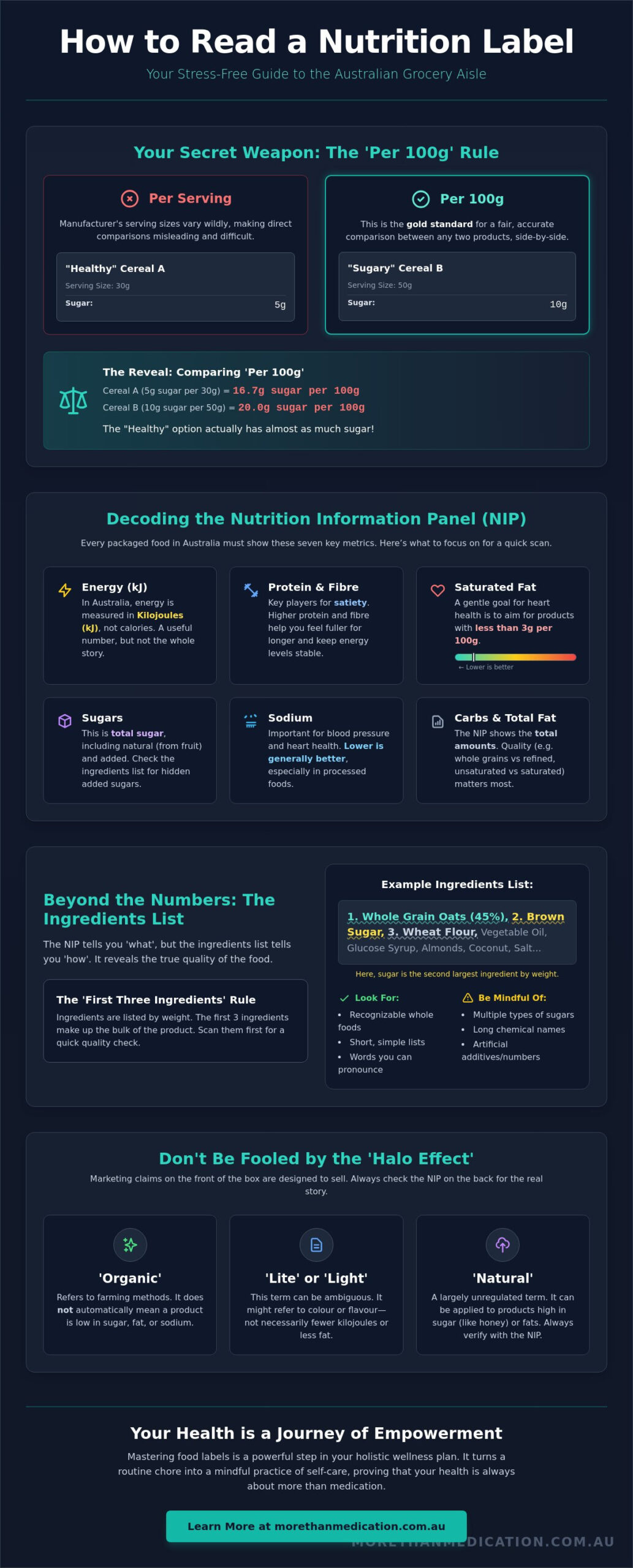
When you look at the NIP, you’ll see two main columns. The ‘Per Serving’ column tells you what you’ll consume based on the manufacturer’s suggested portion. However, these sizes vary wildly between brands. To truly learn how to read a nutrition label correctly, always focus on the ‘Per 100g’ or ‘Per 100ml’ column. This is the gold standard for comparison. It allows you to compare two different boxes of muesli or jars of pasta sauce side by side on an equal playing field, regardless of how big the manufacturer thinks a serving should be.
Understanding Macronutrients on the Label
Protein and fibre are often the highlights of a label. They play a vital role in satiety, helping you feel full and keeping your energy levels steady throughout the day. While the NIP must show total fat, try to pay closer attention to the saturated fat line. Higher amounts of saturated fat are linked to heart health concerns; aiming for products with less than 3g of saturated fat per 100g is a gentle, manageable goal. Carbohydrates are listed as a total, but the ‘sugars’ sub-category includes both naturally occurring sugars, like those in fruit or milk, and added ones. Identifying the difference requires a quick look at the ingredients list below the panel.
Spotting the ‘Hidden’ Ingredients
The ingredients list is your secret weapon for clarity. Items are listed in descending order by weight, meaning the first three ingredients make up the bulk of the product. If sugar or salt appears near the top, it’s a major component. You might not always see the word ‘sugar’ though. Manufacturers use over 50 different names, including maltodextrin, agave syrup, or fruit juice concentrate, to add sweetness.
Sodium is another area where labels can be tricky. Many ‘low fat’ processed options use extra salt to maintain flavour after fat is removed. A helpful rule of thumb is to look for foods with less than 400mg of sodium per 100g. You’ll also notice various numbers in brackets, such as 621 (MSG) or 220 (sulphur dioxide). These are approved additives, but if you find your body reacts to certain foods, keeping a simple diary of these numbers can help you find more balance in your daily wellbeing. Taking these small steps makes the complex journey of nutrition feel much more navigable.
The ‘Per 100g’ Rule: Your Secret Weapon for Fair Comparison
Standing in the cereal aisle can feel like a test you didn’t study for. You want to make the best choice for your health; however, every box makes a different promise. This is where the ‘Per 100g’ column becomes your most reliable companion. While the ‘Per Serving’ column changes based on what a manufacturer decides is a portion, the 100g column stays constant. It allows you to compare two different products side-by-side with total clarity. Knowing how to read a nutrition label correctly starts with looking past the marketing on the front and turning straight to that 100g column.
Why Serving Sizes Can Be Tricky
Manufacturers often set small serving sizes to make the sugar or fat content look lower at first glance. You might see a biscuit pack that lists a serving as just one cookie, even though most people eat two or three. If you only look at the ‘per serving’ numbers, you aren’t getting a realistic picture of your nutritional journey. Learning how to read food labels by focusing on the 100g column is the only way to compare value and nutrition simultaneously. It ensures you’re comparing like for like, rather than a tiny snack size against a generous portion. Always check how many servings are in the packet to avoid accidentally doubling your intended intake.
The ‘Comparison Cheat Sheet’ for Australian Shoppers
Think of these numbers as gentle benchmarks rather than strict rules. They help you find balance and resilience in your diet without the stress of complex math. Use these figures as your guide when looking at the ‘Per 100g’ column:
- Sugar: Aim for less than 15g per 100g. If the product contains whole fruit, this number can be slightly higher as natural sugars are packaged with beneficial vitamins.
- Sodium: Look for under 400mg per 100g to support your heart health. For those managing blood pressure, finding options under 120mg is a significant win.
- Fibre: Choose products with more than 3g per 100g. A higher fibre count is a simple way to support your gut health and keep you feeling full for longer.
A Practical Comparison
Imagine you’re holding two boxes of muesli. Brand A has a serving size of 30g and lists 5g of sugar. Brand B has a serving size of 50g and lists 7g of sugar. At first, Brand A looks like the healthier choice. However, when you check the 100g column, Brand A actually has 16.6g of sugar while Brand B only has 14g. By knowing how to read a nutrition label correctly, you’ve just discovered that Brand B is the better option for your morning routine. This small shift in focus empowers you to take control of your health, reminding you that wellness is a journey of small, informed steps.
Navigating Marketing Claims and Hidden Health Fads
Walking through the grocery aisle often feels like a mental workout. Bright labels and bold claims compete for your attention, frequently using the “Halo Effect” to make products seem healthier than they are. When a box says “Organic” or “Natural”, your brain might skip the fine print, assuming it is a virtuous choice. However, organic cane sugar affects your blood glucose exactly like the conventional kind. Similarly, products labeled “No Added Sugar” can still be packed with concentrated fruit pastes or dates. These are high in naturally occurring sugars that impact your energy levels. Learning how to read a nutrition label correctly means looking past the front-of-pack promises and focusing on the hard data in the panel.
The term “Light” or “Lite” is another common source of confusion. In Australia, if a label refers to a nutrient, it must be at least 25% lower in that nutrient than the reference product. But “light” can also legally refer to the color, flavor, or texture of the food. A “light” olive oil is usually just lighter in taste and color, not lower in calories or fat. Always check the Nutrition Information Panel (NIP) to see if the reduction is in fat, salt, or something else entirely.
Common Marketing Myths Busted
Marketing often highlights facts that are technically true but contextually irrelevant. You have likely seen vegetable oils proudly labeled “Cholesterol-Free”. Since cholesterol is only found in animal products, all plant-based oils have always been cholesterol-free. It is a clever distraction from the total fat content. Likewise, many people reach for “Gluten-Free” snacks as a general health shortcut. For the 1 in 70 Australians living with coeliac disease, this is vital. For others, these products can sometimes be higher in saturated fats and thickeners to mimic the texture of wheat. You can check out our guide on latest health trends to see which fads to avoid as you build your wellness routine.
Using the Health Star Rating Wisely
The Health Star Rating (HSR) system, introduced in Australia in 2014, provides a quick visual cue from 0.5 to 5 stars. It is a helpful tool for a snap decision, but it has specific limits. Stars are calculated based on categories. This means a 4-star yoghurt is being compared to other yoghurts, not to a bag of nuts or a piece of fruit. You might see a 3-star pack of raw almonds and think they are “worse” than a 4-star sweetened cereal, but the almonds offer healthy fats and fiber that the stars do not fully capture. To truly master how to read a nutrition label correctly, use the stars as a starting point. Then, verify the sodium and sugar levels in the NIP if you are managing a specific condition like hypertension or diabetes.
If you are feeling overwhelmed by conflicting food advice, remember that small, informed choices lead to lasting change. Explore more ways to support your holistic journey at More Than Medication.
Building a Mindful Shopping Routine: From Overwhelmed to Empowered
Walking through the aisles of a local Woolworths or Coles can often feel like a sensory overload. You are met with bright packaging and bold health claims that make it difficult to know what’s actually inside. You don’t need to change every habit in a single trip. Mastering how to read a nutrition label correctly is a marathon, not a sprint. We suggest starting small by choosing one category to master each week. Perhaps this week you focus on bread, and next week you tackle breakfast cereals. By narrowing your focus, you build confidence without the fatigue of over-analysis.
Involving your family in this process can transform a routine chore into a shared journey of discovery. Instead of making label reading a lecture, turn it into a quick scavenger hunt for the kids. Ask them to find the yogurt with the lowest sugar or the crackers with the most seeds. This builds their nutritional literacy while taking the pressure off you to be the sole “food police” in the household.
The 30-Second Label Scan
You don’t need to spend minutes deconstructing every box. A quick, three-step scan can tell you most of what you need to know in about 30 seconds. This method helps you stay focused and prevents the feeling of being bogged down by data.
- Step 1: Check the 100g column. In Australia, labels must include a “per 100g” column. This is your best tool for an apples-to-apples comparison between brands. Look for products with less than 15g of sugar and under 400mg of sodium per 100g to keep your heart and energy levels stable.
- Step 2: Scan the first three ingredients. Ingredients are listed by weight. If the first three items are sugar, salt, or refined oils, the product is likely low in actual nourishment. You want to see “real” whole foods like oats, nuts, or vegetables at the top of the list.
- Step 3: Look for the fibre count. For long-lasting energy and digestive health, aim for products that offer at least 3g of fibre per serving. Fibre slows down the absorption of sugar, preventing that mid-afternoon energy crash.
Nourishing Your Whole Self
Health is about more than a set of numbers on a cardboard packet; it’s about the connection you feel at a family Sunday roast and the culture reflected in your favourite meals. Practising self-compassion means embracing the 80/20 rule. If you focus on nutrient-dense, whole foods 80% of the time, there’s plenty of room for the 20% that is purely for joy and celebration. This balance is essential for long-term resilience and mental wellbeing.
If you find that many store-bought options don’t meet your needs, taking back control in the kitchen is a powerful step. You can use healthy slice recipes to create nutrient-dense snacks at home where you have total authority over the sugar and fat content. This holistic approach ensures your body gets what it needs while your mind stays at ease.
Every time you practice how to read a nutrition label correctly, you are advocate for your own health. Remember that you are more than your diet, and medicine is only one piece of the puzzle. Your journey is unique, and every small, mindful choice you make in the supermarket aisle is a significant victory for your future self.
Embracing Your Path to Mindful Nourishment
Learning how to read a nutrition label correctly is a quiet, powerful act of self-care. It’s about taking the pressure off and giving yourself the tools to choose what truly nourishes your body. By focusing on the “Per 100g” column, you bypass the confusion of varying serving sizes and gain the clarity needed to compare products fairly. This simple shift helps you see past the flashy marketing claims that often crowd Australian supermarket shelves. The Food Standards Australia New Zealand (FSANZ) Code ensures every label follows specific guidelines, but the real empowerment comes when you use that data to support your unique physical and mental wellbeing.
Your health journey is about much more than a single meal or a specific diagnosis. It’s a holistic experience that requires patience and steady support. We provide expert-led nutrition advice and evidence-based health trends to help you navigate these daily choices with confidence. For more empathetic, patient-centric support on living a balanced lifestyle, explore our latest wellness guides. Remember that medicine is just one piece of your health puzzle. You’re building a lifestyle that honors the whole person, and every small, informed step you take today creates a foundation for a more resilient tomorrow.
Frequently Asked Questions
Is ‘Sugar-Free’ actually better for me?
Not necessarily, as “sugar-free” foods often use intensive sweeteners or extra fats to maintain their flavor. Under Food Standards Australia New Zealand (FSANZ) guidelines, a product can claim this if it contains less than 0.5 grams of sugar per 100 grams. While these options might help manage blood glucose, they aren’t always the most nourishing choice. You’ll find it’s more helpful to look at the whole ingredient list to ensure you’re getting balanced nutrition.
How do I read a nutrition label if I have high blood pressure?
You should focus primarily on the sodium line to manage your heart health effectively. Learning how to read a nutrition label correctly allows you to identify “low salt” foods, which the Heart Foundation defines as having less than 120mg of sodium per 100g. If a product has more than 400mg per 100g, it’s considered high. Making this small shift in your grocery routine can significantly support your blood pressure journey and long-term wellbeing.
What is the difference between ‘Total Fat’ and ‘Saturated Fat’ on a label?
Total fat represents every type of fat in the food, while saturated fat is the specific type you should limit for heart health. The Australian Dietary Guidelines recommend that saturated fat makes up less than 10% of your daily energy intake. When you compare two similar products, choose the one with the lowest saturated fat per 100g. It’s a simple way to nourish your body without feeling overwhelmed by complex numbers or medical jargon.
Why does some fruit have a high sugar count on the label?
Fruit contains natural sugars called fructose, which the body processes differently than the “added sugars” found in processed snacks. An average Australian apple contains about 19 grams of sugar, but it also provides 4.4 grams of fiber that slows down sugar absorption. You don’t need to fear the sugar in whole fruits. These labels reflect the total package of nutrients that help your body feel vibrant and energized throughout the day.
Does ‘Made in Australia’ mean the ingredients are healthier?
No, this label indicates where the food was processed rather than its nutritional quality. The ACCC requires the kangaroo logo to show the percentage of Australian ingredients, but a high-salt snack can still be “Australian Made.” It’s wonderful to support local farmers, but you still need to check the nutrition information panel. Understanding how to read a nutrition label correctly ensures you’re choosing quality fuel for your unique health journey regardless of where it’s packed.
How can I tell if a product is truly ‘Whole Grain’?
You can identify genuine whole grains by checking if “whole grain” or “wholemeal” appears as the first or second ingredient. The Grains & Legumes Nutrition Council suggests looking for products that offer at least 8 grams of whole grain per serving. Don’t be fooled by brown coloring or words like “multigrain,” which might just mean many types of refined grains. Real whole grains provide the steady, lasting energy your body craves.
What should I look for on a label if I’m always tired?
You should look for iron and B-vitamin content if you’re struggling with low energy levels. Statistics from the Australian Bureau of Statistics show that 1 in 4 Australian women don’t get enough iron. While the nutrition panel doesn’t always list these, many fortified cereals and breads show iron levels in milligrams. Taking a moment to find these nutrients is a gentle way to support your physical resilience when life feels particularly demanding.
Can I trust the Health Star Rating on the front of the pack?
The Health Star Rating is a helpful tool for comparing similar items, but it isn’t a perfect measure of your total health. A 2023 government report showed that 28% of Australians use these stars to make better choices at the shelf. However, the system compares “like with like,” so a 4-star cereal is better than a 2-star cereal, but it isn’t necessarily better than a fresh egg. Use it as a quick guide while you’re learning.
⚕️ Medical Disclaimer
This content is for informational purposes only and is not a substitute for professional medical advice, diagnosis, or treatment. Always seek the advice of your doctor or other qualified health provider with any questions you may have regarding a medical condition. Never disregard professional medical advice or delay in seeking it because of something you have read on this website.