
What if the reason you can’t stick to a plan isn’t a lack of willpower, but a simple cognitive glitch in how your brain processes success? With 49% of U.S. adults resolving to start a new diet in 2026, many of us find ourselves trapped in a cycle of perfectionism followed by inevitable failure. You might feel like one unplanned indulgence ruins the entire day, leading to a spiral of guilt and mental exhaustion. Learning how to stop all-or-nothing thinking with diet starts with recognizing that your health is about more than just a strict set of rules; it’s about the resilience of your mindset.
To help you integrate these various pillars into your daily routine, you can learn more about 1-on-1 Health Coaching and see how a tailored approach can support your specific health goals.
It’s exhausting to feel like you’re constantly walking a tightrope where one slip-up means falling off completely. We understand how heavy that food noise can feel when you’re just trying to live a balanced life. This guide will show you how to break the perfectionism trap and build a compassionate, sustainable relationship with your body. We’ll explore the Dimmer Switch framework to help you find consistency without the need for perfection, ensuring your mental wellbeing remains as much a priority as your physical health.
Key Takeaways
- Identify the evolutionary reasons your brain prefers binary choices and how to outsmart the psychological shortcuts that lead to the “I’ve ruined it” syndrome.
- Shift your perspective using the “Dimmer Switch” mentality to understand how to stop all-or-nothing thinking with diet by valuing progress on a spectrum of 1 to 10.
- Transform your relationship with food by auditing your vocabulary and removing shame-based labels like “cheat” or “sinful” that often trigger feelings of failure.
- Adopt the 80/20 rule as a non-negotiable framework for flexibility, allowing you to enjoy social events without the mental exhaustion of constant food tracking.
- Explore the vital intersection of mental and physical health, focusing on how stress management and sleep are essential pieces of your long-term nutritional journey.
Understanding the “All-or-Nothing” Trap in Nutrition
Have you ever eaten a single biscuit and felt like your entire day of healthy eating was a total failure? This experience is the heart of the all-or-nothing trap. In clinical terms, this is called dichotomous thinking. It’s one of several common cognitive distortions where your brain insists on viewing the world in extreme, binary categories. You’re either “on” a diet or “off” it; you’re either a “success” or a “failure.” There’s no room for the gray area where real life actually happens.
When you operate in this mindset, the “I’ve ruined it” syndrome becomes an almost daily occurrence. You tell yourself that since the plan is broken, you might as well eat whatever you want for the rest of the weekend and start over on Monday. This isn’t a lack of discipline. It’s a mental habit that creates a painful cycle of guilt and shame. These heavy emotions don’t help you reach your goals; they just make the journey feel exhausting. Learning how to stop all-or-nothing thinking with diet is about realizing that your health is a long-term practice, not a test you pass or fail every morning.
The “Good Food” vs. “Bad Food” Fallacy
Moralizing nutrition is one of the quickest ways to create psychological pressure. When you label foods as “good” or “bad,” you inadvertently label yourself as “good” or “bad” for eating them. This creates a scarcity mindset where “forbidden” foods become much more attractive and harder to resist. Food neutrality is the foundation for sustainable eating habits. It means recognizing that no single food has the power to make or break your health. By removing the moral weight from your plate, you can make choices based on how food makes you feel rather than a rigid set of rules.
Signs You Are Stuck in the Perfectionist Cycle
Identifying the red flags of perfectionism is the first step toward food freedom. You might be stuck in this cycle if you find yourself:
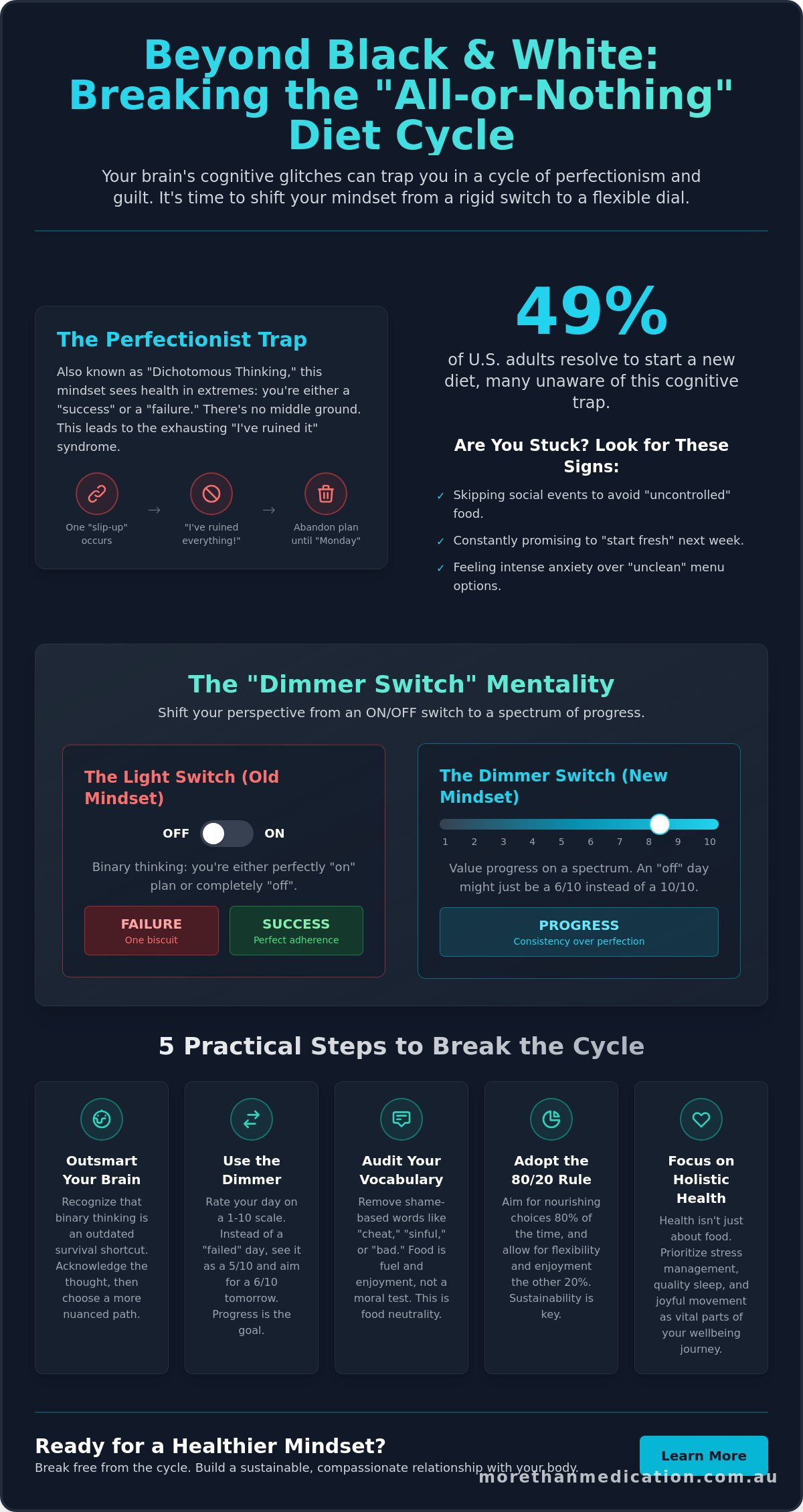
- Skipping social events or dinners with friends because you can’t control the ingredients or track the calories perfectly.
- Delaying your health goals by promising to “start fresh” next week after a minor indulgence.
- Feeling a sense of panic or intense anxiety when you can’t find a “clean” option on a menu.
This rigid mindset often leads people to jump between the latest health trends and fads that promise instant results but ignore the nuances of mental wellbeing. True health is about consistency over time, not the occasional burst of perfection. It’s about finding a rhythm that supports your body and your mind simultaneously.
The Psychology of Cognitive Distortions: Why Our Brains Think in Black and White
Your brain is wired for efficiency, not necessarily for the complexities of a modern supermarket. Historically, binary thinking was a survival mechanism. Our ancestors had to decide quickly if something was edible or poisonous, a friend or a foe. This ancient hardwiring is why your mind naturally gravitates toward common thinking traps when you’re trying to change your habits. Modern diet culture exploits this by selling “quick fix” programs that promise total transformation in 30 days. These programs thrive on the idea that you’re either perfectly adhering to the rules or you’re failing completely, leaving no room for the reality of daily life.
Neurologically, this struggle happens between your prefrontal cortex and your amygdala. The prefrontal cortex is the logical part of your brain that understands long-term goals. The amygdala, however, is your emotional center. When you “break” a diet rule, the amygdala perceives it as a threat to your safety, triggering a stress response. This often leads to the very overeating you’re trying to avoid. Understanding this biological tug-of-war is a vital step in learning how to stop all-or-nothing thinking with diet. The good news is that your brain possesses neuroplasticity. You can literally retrain your neural pathways to recognize the “grey area” where sustainable health exists. By consistently practicing small, flexible choices, you strengthen the connections in your prefrontal cortex. Over time, the middle ground becomes your new default setting rather than a source of anxiety.
The Perfectionism-Procrastination Connection
When you set high-pressure goals, the fear of not doing things perfectly can be paralyzing. This often leads to “procrastinatory eating” or avoiding healthy changes altogether because the perceived cost of failure is too high. This stress response makes it harder to access your rational mind, often resulting in emotional eating as a way to self-soothe. Instead of protecting you, the desire for perfection actually keeps you stuck in a cycle of inaction and frustration.
Retraining Your Internal Monologue
Learning how to stop all-or-nothing thinking with diet requires a shift in how you talk to yourself. Pay close attention to “should” and “must” statements; these words fuel the all-or-nothing fire. Instead of saying, “I failed today,” try reframing it: “I made one choice that didn’t align with my goals, and I can choose differently at my next meal.” This simple shift moves you from judgment to observation. If you’re looking for more ways to support your journey, exploring our expert advice on mental health can help you build a more compassionate and resilient mindset.
The “Dimmer Switch” Mentality: Choosing Progress Over Perfection
Imagine your health journey is controlled by a dimmer switch rather than a standard on-off light switch. Most of us are taught that if we aren’t performing at a level 10—perfect tracking, zero sugar, and daily exercise—we might as well be at level 0. This binary approach is why so many people struggle to maintain their goals. Learning how to stop all-or-nothing thinking with diet involves realizing that even on your busiest, most stressful days, you can simply turn the dial down to a 3 or 4 instead of clicking it off entirely.
Staying “in the game” means making the best choice available in your current circumstances. If you’re at a busy airport and can’t find your usual meal prep, a simple turkey sandwich is a “4” or “5.” It’s far better for your metabolic and mental health than giving up and overeating because the day is “ruined.” This philosophy mirrors a balanced fitness approach where a ten-minute walk on a tired day is more valuable for long-term resilience than a grueling hour-long session followed by a week of total inactivity.
Perfectionism vs. Sustainable Progress
We often overvalue the intensity of our efforts while undervaluing their consistency. With 49% of U.S. adults starting new diets in 2026, the pressure to maintain peak intensity is higher than ever. However, the most successful individuals are those who stay at a level 5 or 6 consistently. Consider the difference between these two mindsets:
- Rigid Rules: Relies on “forbidden” lists and strict adherence, often fueled by a fear of failure.
- Flexible Guidelines: Focuses on values and self-care, allowing for adjustments based on your daily energy.
- Guilt-Driven: Every slip-up feels like a moral failing that requires “punishment” or starting over.
- Value-Driven: Every choice is an opportunity to learn what makes your body feel its best.
A “perfect” week followed by a “zero” week creates a psychological roller coaster. Knowing how to stop all-or-nothing thinking with diet helps you see that two “average” weeks are actually more effective for your long-term health than one week of perfection followed by total abandonment.
The Power of the “Grey Area”
A “grey area” meal is one that balances health goals with the reality of being human. It might look like having a nutritious salad but adding a side of chips because you genuinely want them. It could be choosing the grilled chicken option at a restaurant but still sharing a dessert with a friend. These choices aren’t failures; they’re essential practice for a peaceful relationship with food. Flexibility is a prerequisite for long-term physiological and psychological health. Without it, your diet becomes a source of chronic stress, which can negatively impact your digestion and hormonal balance.
5 Practical Steps to Break the Cycle Today
Transitioning from the theory of the “dimmer switch” to daily action requires a series of gentle, intentional shifts. These steps aren’t about adding more rules to your life. Instead, they’re designed to help you dismantle the rigid structures that keep you stuck. Understanding how to stop all-or-nothing thinking with diet is a process of unlearning old habits while building a more resilient mindset.
- Step 1: Audit your language. Words like “cheat,” “sinful,” and “clean” turn nutrition into a moral battleground. When you eat a “sinful” food, you feel like a “sinner,” which triggers a shame response. Replace these with neutral terms like “nutrient-dense” or “energy-dense” to lower the emotional stakes.
- Step 2: Practice the 80/20 rule. This framework suggests that 80% of your choices focus on nourishment while the other 20% allow for pure enjoyment. It provides a built-in safety net that prevents the “I’ve ruined it” spiral.
- Step 3: Implement the “Never Miss Twice” rule. Slips are inevitable in a world where the typical American consumes 24% more calories daily than in 1961. If you have a meal that doesn’t align with your goals, simply make your next meal a nourishing one. This stops a single choice from turning into a week-long detour.
- Step 4: Focus on “Add, Don’t Subtract.” Instead of thinking about what you need to cut out, ask what you can add. Can you add a handful of spinach to your pasta? Can you add a source of protein to your snack? This shifts your focus from deprivation to abundance.
- Step 5: Develop a self-compassion ritual. When things don’t go as planned, take three deep breaths and remind yourself that your worth is not tied to your plate. Resilience is built in the moments you choose to be kind to yourself after a setback.
Practical Tools for Your Kitchen
Building a supportive environment is key to maintaining consistency. On low-energy days, the temptation to abandon your goals is highest. Having “emergency” meals in your freezer, such as pre-cooked grains or frozen vegetables, can bridge the gap between perfection and “good enough.” You can also satisfy your sweet tooth using nutrient-dense recipes that provide both flavor and function without the subsequent guilt of a sugar crash.
Navigating Social Situations Without Stress
Social eating is often where all-or-nothing thinking thrives. To manage this, try the “one plate” rule at gatherings; fill your plate once with a mix of things you love and things that nourish you, then focus on the conversation. If you encounter “food pushers” who insist you try everything, a polite but firm “that looks delicious, but I’m satisfied right now” helps maintain your boundaries. If you’re looking for more ways to navigate these challenges, explore our expert advice on living a balanced lifestyle for continued support.
Cultivating Holistic Wellbeing: Health is More Than Your Plate
At More Than Medication, we believe that your health is far more than a collection of numbers on a scale or a list of calories consumed. The “more” in our name serves as a constant reminder that while expert nutrition advice is a foundation, your mental state is the architect of your wellbeing. In 2026, many consumers are reporting high levels of uncertainty and anxiety, which often leads to using food as a primary tool for emotional comfort. Learning how to stop all-or-nothing thinking with diet involves acknowledging these emotional needs rather than suppressing them with rigid rules. When you view yourself as a whole person, you begin to see that a peaceful mind is just as vital as a nourished body.
True health is supported by several pillars that exist far beyond your kitchen. Research shows that 59% of consumers now believe gut health is a key component of their overall wellbeing, yet the health of your microbiome is deeply influenced by your stress levels and sleep quality. If you’re perfectly following a meal plan but only sleeping four hours a night, your body isn’t truly thriving. Social connection also plays a massive role in our relationship with food. Eating should be a source of community and joy, not a solitary exercise in tracking and restriction. By shifting your focus toward these holistic factors, you reduce the pressure on every single meal to be “perfect.”
The Mental-Physical Health Connection
When you’re trapped in a cycle of perfectionism, your body stays in a state of high alert. This chronic dieting stress increases cortisol levels, which can actually hinder your physical health goals and lead to increased inflammation. Mindfulness is a powerful tool to break this physiological response. By being present and non-judgmental during your meals, you improve your digestion and increase your sense of satisfaction. This practice helps you move away from the anxiety of “doing it right” and toward the simple pleasure of nourishing your body. It’s about finding a rhythm that feels supportive rather than punitive.
Next Steps: Your Journey Beyond the Scale
Healing your relationship with food is a marathon, not a sprint. If you find that all-or-nothing thinking feels unmanageable or deeply distressing, seeking professional support through our expert advice on mental health can provide you with personalized tools for your specific journey. Remember that your self-worth isn’t tied to a morning weigh-in or a “perfect” day of eating. Health is a lifelong journey of resilience, balance, and self-compassion. You have the power to redefine what success looks like, one gentle choice at a time. Stay consistent, stay kind to yourself, and remember that you’re always worth more than your diet.
Embracing Your Path to Lasting Food Freedom
Your relationship with food shouldn’t be a source of constant anxiety or mental exhaustion. Since 49% of U.S. adults resolved to change their eating habits in 2026, the pressure to be perfect is immense, yet true health thrives in the middle ground. By understanding the evolutionary roots of black-and-white thinking, you can begin retraining your brain to value consistency over perfection. You now have a practical framework to stay in the game, whether you’re using the 80/20 rule or the dimmer switch mentality to navigate daily life. Remember that your health is a whole-person experience where mental wellbeing is just as critical as physical nutrition. Learning how to stop all-or-nothing thinking with diet is a significant milestone in your journey toward a more balanced life.
Discover more expert advice on achieving a balanced lifestyle with More Than Medication. We provide expert-led nutrition insights and empathetic, non-judgmental guidance through our holistic approach to mental and physical health. You’re capable of building a sustainable, peaceful relationship with your body. Every small, compassionate choice you make today is a powerful victory for your future self.
Frequently Asked Questions
What exactly is all-or-nothing thinking in a diet context?
All-or-nothing thinking is a cognitive distortion that forces you to see your nutrition as either 100% successful or a complete failure. Understanding how to stop all-or-nothing thinking with diet involves recognizing that health exists on a spectrum rather than a binary “on” or “off” switch. When you operate in this mindset, a single unplanned snack feels like it justifies abandoning your goals for the rest of the week.
How can I stop feeling guilty after eating something “unhealthy”?
You can stop the guilt by practicing food neutrality and removing moral labels like “bad” or “sinful” from your vocabulary. Remind yourself that one meal is just one data point in a lifetime of eating. By shifting your focus to how food makes you feel physically rather than how it fits a rigid rule, you reduce the emotional weight that leads to shame.
Is the 80/20 rule actually effective for long-term health?
The 80/20 rule is highly effective because it builds psychological flexibility, which is the cornerstone of sustainability. Nearly 49% of U.S. adults set new diet resolutions in 2026, yet those who adopt flexible frameworks are far more likely to maintain their progress. This approach allows you to enjoy social events and favorite treats without the mental exhaustion of constant restriction.
What should I do if I have a binge after a period of strict dieting?
If a binge occurs, the most important step is to return to your normal, nourishing routine immediately without any form of punishment or restriction. Learning how to stop all-or-nothing thinking with diet requires you to treat each meal as an independent event. Avoid skipping the next meal to “make up” for the binge, as this only reinforces the biological hunger cycle that triggers future overeating.
Can all-or-nothing thinking be a sign of an eating disorder?
Yes, persistent black-and-white thinking can sometimes indicate disordered eating patterns or conditions like orthorexia. If you find that these thoughts cause significant anxiety, social isolation, or physical distress, it’s helpful to seek expert advice on mental health. Professional support can provide you with specific tools to navigate the complex intersection of your emotional and physical wellbeing.
How do I explain my new flexible approach to friends and family?
Explain your approach by focusing on your desire for long-term consistency rather than short-term extremes. You might say, “I’m focusing on a balanced lifestyle that allows for flexibility so I can enjoy these moments with you.” This sets a clear boundary while showing that your health journey is about resilience and joy rather than restriction and rules.
Is it possible to lose weight without a rigid “all-in” mentality?
Sustainable weight management is actually more likely when you move away from rigid extremes and toward moderate, consistent habits. The health and wellness food market is expected to grow by $180 billion between 2024 and 2026, reflecting a global shift toward individualized nutrition. Success comes from the small, manageable choices you make 80% of the time, not the perfect choices you make for just a few days.
What are some simple phrases I can use to reframe my thoughts about food?
Use phrases that emphasize choice and curiosity rather than judgment or “should” statements. Instead of saying, “I’ve ruined my day,” try saying, “I’m practicing flexibility, and my next meal is a fresh start.” You can also replace “I can’t have that” with “I can have that if I want it, but right now I’m choosing something that gives me more energy.”
⚕️ Medical Disclaimer
This content is for informational purposes only and is not a substitute for professional medical advice, diagnosis, or treatment. Always seek the advice of your doctor or other qualified health provider with any questions you may have regarding a medical condition. Never disregard professional medical advice or delay in seeking it because of something you have read on this website.