
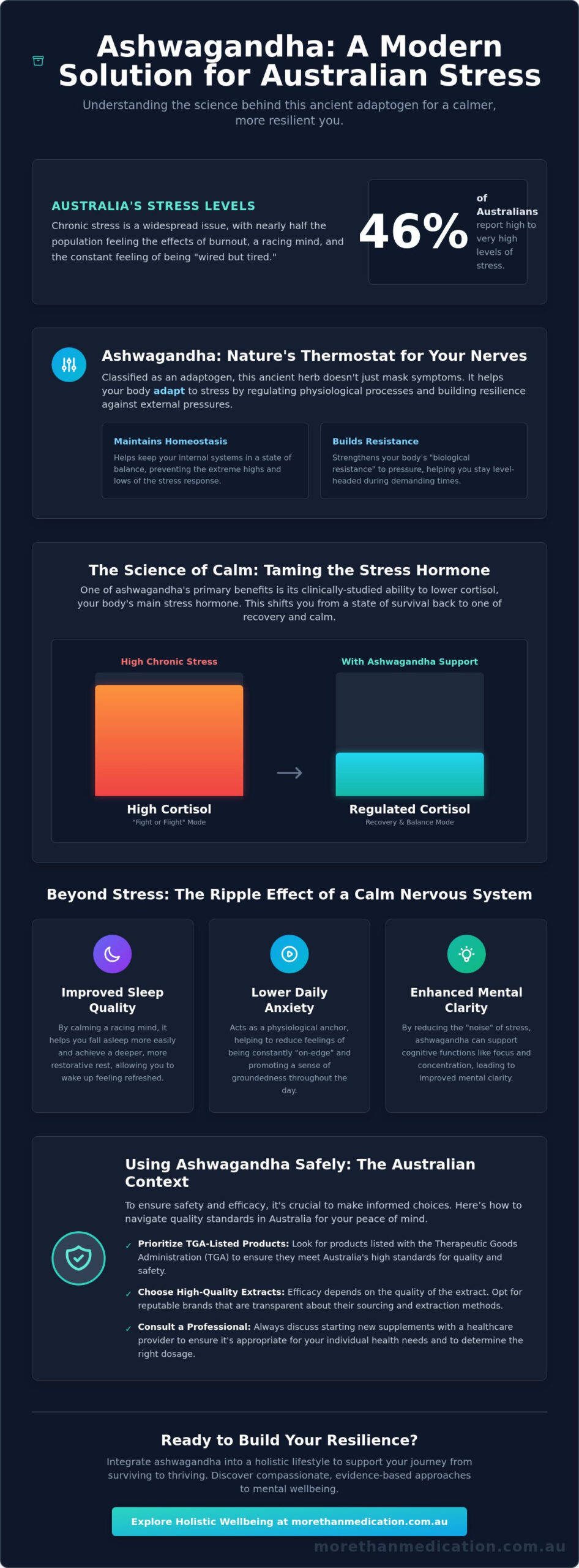
Did you know that 46% of Australians now report experiencing high to very high levels of stress? If you’ve felt the weight of chronic burnout or the frustration of a racing mind that won’t switch off at night, you’re certainly not alone. Exploring the benefits of ashwagandha for stress can offer a path toward finding your center again. It’s exhausting to live in a state of constant “on,” where high cortisol symptoms make even small tasks feel like mountains. You deserve a moment of calm, and you’re likely looking for a way to find it that doesn’t feel like another passing wellness fad.
This ancient herb acts as a physiological anchor, helping to recalibrate your body’s response to pressure rather than just masking the symptoms. By focusing on how this adaptogen supports your nervous system, you can move from a place of survival to one of steady, quiet strength. We’ll explore the evidence-based ways ashwagandha improves sleep quality and lowers daily anxiety. We’ll also cover essential Australian safety standards, including the latest TGA advisories and how to identify quality products, so you can make informed decisions for your holistic wellbeing.
Key Takeaways
- Learn how ashwagandha acts as a biological anchor, helping your body return to a state of balance even during demanding times.
- Discover the evidence-based benefits of ashwagandha for stress and how it works to lower high cortisol levels that keep you feeling “wired but tired.”
- Explore the connection between a calm nervous system and improved sleep hygiene, allowing you to wake up feeling truly restored.
- Gain practical knowledge on navigating Australian safety standards, including how to identify TGA-listed products for your peace of mind.
- See how to integrate this adaptogen into a holistic lifestyle that prioritizes both mental clarity and physical recovery.
Understanding Ashwagandha: The Ancient Adaptogen Meeting Modern Australian Stress
If you’ve ever felt like your internal battery is permanently drained, you aren’t alone. In Australia, nearly 46% of adults report experiencing high to very high levels of stress, a figure that has climbed steadily in recent years. This collective sense of burnout has led many to look beyond quick fixes toward more grounded, time-tested solutions. This is where ashwagandha enters the conversation. A small, unassuming shrub native to the dry regions of Asia and Africa, this ancient adaptogen has become a cornerstone for those seeking a natural way to steady their nerves. It’s more than just a passing fad; it’s a botanical ally that helps you navigate the demands of a busy life with a bit more grace.
When we talk about the benefits of ashwagandha for stress, we’re looking at how it helps the body find its center. At More Than Medication, we believe that supplements work best when they’re part of a broader, compassionate approach to health. They aren’t meant to replace the foundations of good rest or professional care. Instead, they act as a supportive piece of your personal wellness puzzle. Understanding how this plant interacts with your system is the first step in reclaiming your sense of calm and building long-term resilience.
What are Adaptogens and How Do They Work?
The term “adaptogen” might sound like scientific jargon, but the concept is beautifully simple. Think of an adaptogen as a thermostat for your nervous system. Just as a thermostat keeps a room from getting too hot or too cold, adaptogens help your body maintain homeostasis. They build your “biological resistance” to external pressures, helping you stay level-headed when things get chaotic. Unlike stimulants that give you a temporary jolt or sedatives that might leave you feeling groggy, ashwagandha works subtly. It encourages your body to self-regulate; it ensures your internal environment remains stable regardless of what’s happening in your external world.
From Ayurveda to Global Wellness Trends
While it might feel like a new discovery, ashwagandha has a rich 6,000-year history in Ayurveda, the traditional natural healing system of India. It has stood the test of time for a reason. Recently, this ancient wisdom has merged with modern science, securing its place among the latest health trends of 2026. Scientific interest has peaked as researchers look for evidence-based ways to support mental health. With the global market projected to grow at a rate of 9.3% through 2034, it’s clear that the world is waking up to the benefits of ashwagandha for stress. This shift reflects a deeper desire for plant-based solutions that respect the complex connection between our minds and our bodies.
The Science of Calm: How Ashwagandha Manages Cortisol and the Stress Response
To understand why you feel constantly “on edge,” we have to look at cortisol. This is your body’s primary stress hormone, acting much like a built-in alarm system. In small, occasional doses, cortisol is actually quite helpful; it keeps you alert and helps you react to immediate challenges. However, when the pressures of daily life never seem to let up, your “fight or flight” response stays permanently active. Your system becomes flooded with cortisol, leading to that familiar feeling of being wired but tired. One of the most researched benefits of ashwagandha for stress is its ability to help lower these circulating cortisol levels, effectively telling your body that the danger has passed.
Clinical findings have been quite remarkable in this area. Studies often show that participants taking high-quality extracts experience a significant reduction in cortisol compared to those taking a placebo. This isn’t just about feeling better in your mind; it’s about a measurable change in your body’s chemistry. Ashwagandha acts as a chemical buffer, softening the impact of cortisol on the brain and body. By dampening this hormonal surge, the herb helps you move out of a state of survival and back into a state of recovery. If you’re looking for more ways to support your journey toward balance, our expert advice on mental health can help you build a complete toolkit for resilience.
Regulating the HPA Axis
The Hypothalamic-Pituitary-Adrenal (HPA) axis is the communication highway between your brain and your adrenal glands. Think of it as the command center for your stress response. When you’re overwhelmed, this system sends out constant SOS signals, keeping your sympathetic nervous system in overdrive. Ashwagandha helps by “quieting” these overactive signals. It encourages the HPA axis to function more efficiently, ensuring your body doesn’t overreact to every minor frustration. By soothing this system, the plant helps your body manages cortisol and the stress response with much greater ease.
The Role of Withanolides
The true power of this herb lies in active compounds called withanolides. These are the biological drivers responsible for the benefits of ashwagandha for stress. When you’re exploring different options, the concentration of withanolides is a key factor in how effective the supplement will be. Higher concentrations generally lead to more consistent results in clinical trials. While research into their anti-inflammatory properties is still evolving, we know these compounds are essential for helping your nervous system find its footing again. They provide the steady support your body needs to begin the process of long-term healing.
Beyond Stress: Secondary Benefits for Sleep, Focus, and Mental Clarity
While we’ve discussed how this herb balances your internal chemistry, the real-world impact ripples through almost every part of your day. When you aren’t constantly fighting a sense of overwhelm, you often find that your focus returns and your body recovers with more ease. One of the most significant benefits of ashwagandha for stress is how it clears the path for other healthy habits to take root. For instance, it can become a powerful ally in your physical fitness journey. When your system isn’t stuck in a survival state, it can finally prioritize muscle repair and energy restoration after a long day or a heavy workout.
There’s a common fear that taking something to “calm down” might leave you feeling emotionally flat or detached. It’s important to clarify that ashwagandha doesn’t numb your emotions. Instead, it acts like a buffer, giving you the mental space to experience your feelings without being hijacked by them. You remain yourself; you’re just a version of yourself that’s better equipped to handle the daily weather of life. Understanding the multifaceted benefits of ashwagandha for stress means seeing it as a tool for resilience rather than a way to switch off your personality.
Breaking the Stress-Insomnia Cycle
High cortisol levels in the evening are often the silent reason you can’t drift off. Your body thinks it needs to stay alert, which prevents you from entering the deep, restorative stages of REM sleep. An NIH review on ashwagandha for stress points to evidence that this herb can significantly improve sleep latency. This means you fall asleep faster and stay asleep longer. It’s a beautiful cycle; when you sleep better, your body becomes naturally more resilient to the pressures of the following day, reducing the overall burden on your nervous system.
Cognitive Support and “Brain Fog” Reduction
When you’re stressed, your brain often feels like it’s wading through thick fog. Concentration slips and memory feels unreliable because your mind is too busy scanning for perceived threats. By protecting your nerve cells from oxidative stress, ashwagandha helps lift that mental haze. Many users report improved reaction times and a better ability to stay in a “flow” state during complex tasks. It’s not about forcing focus; it’s about removing the obstacles that stress puts in your way, allowing your natural mental clarity to shine through again.
Using Ashwagandha Safely: Dosage, Quality, and the Australian Context
Navigating the supplement aisle can feel overwhelming when you’re already exhausted. In Australia, we have a unique advantage: the Therapeutic Goods Administration (TGA). When you’re looking to experience the benefits of ashwagandha for stress, always look for an ‘AUST L’ or ‘AUST R’ number on the label. This ensures the product is listed on the Australian Register of Therapeutic Goods and meets strict safety and quality standards. As of early 2024, there were approximately 320 ashwagandha medicines legally listed in Australia. Choosing these regulated products means you’re getting exactly what’s on the tin, which is essential for both your peace of mind and your results.
Reading the label requires a little bit of detective work. Look for “extract” rather than just “root powder.” Extracts are concentrated, meaning you get a higher dose of those helpful withanolides we discussed earlier. Most clinical trials find that a daily dosage between 300mg and 600mg is the sweet spot for most adults. The timing depends entirely on your personal goals. If you’re using it to sharpen your focus during a hectic workday, a morning dose might be best. If your main goal is to improve sleep quality, taking it with your evening meal can help your body wind down. For more tailored guidance on your journey, you can explore our expert advice on living a balanced lifestyle to see how supplements fit into your broader routine.
Safety, Side Effects, and Important Contraindications
While generally well-tolerated, some people may experience mild side effects like nausea, stomach upset, or slight drowsiness. It’s also vital to be aware of a February 2024 TGA safety advisory. In very rare cases, ashwagandha has been linked to liver injury. If you notice symptoms like yellowing of the skin or eyes, dark urine, or unusual tiredness, stop use immediately and see a doctor. This herb isn’t suitable for everyone. Pregnant or breastfeeding women, and those with autoimmune conditions, should generally avoid it. Always speak with your GP before starting, especially if you have a history of liver problems or are taking other medications.
How Long Does It Take to Work?
It’s natural to want quick relief when you’re feeling burnt out. However, ashwagandha is a slow-acting ally. It isn’t an instant fix; it works by gradually recalibrating your body’s internal systems. Most research shows that the full benefits of ashwagandha for stress are typically felt after 8 to 12 weeks of consistent use. Think of it as a marathon rather than a sprint. By taking a steady, patient approach, you allow your nervous system the time it needs to truly rebuild its resilience. This gentle pace is often more sustainable for long-term mental and physical health.
A Holistic Approach: Integrating Ashwagandha into Your Daily Wellbeing Routine
True health isn’t found in a single bottle. At More Than Medication, we believe that supplements are precisely that; they are supplemental. They work best when they support a sturdy foundation of rest, movement, and connection. While the benefits of ashwagandha for stress are well-documented, this herb is most effective when it helps you create the space to implement larger lifestyle changes. It is a knowledgeable companion that quietens the noise so you can hear what your body actually needs. By lowering your physiological baseline for anxiety, it empowers you to make choices that serve your long-term vitality.
Think about how you can layer these supportive habits to create a comprehensive safety net for your nervous system. For example, pairing your herbal routine with a remedial massage can address the physical tension that ashwagandha helps soothe from the inside out. When your muscles are relaxed and your cortisol is regulated, your path to recovery feels much less steep. Nutrition also plays a vital role in this balance. Instead of reaching for sugary snacks when your energy dips, consider preparing healthy slice recipes that provide sustained, nutrient-dense fuel. These small, intentional choices signal to your system that it is safe, nourished, and supported. Every time you choose a whole food or a moment of movement, you are reinforcing the benefits of ashwagandha for stress.
Ashwagandha as a Supplemental Tool, Not a Sole Solution
No herb can “fix” a lifestyle defined by chronic overwork or a lack of boundaries. However, ashwagandha can lower the physiological “volume” of your stress response. This creates a vital window of mental clarity where meditation or therapy becomes more accessible. It gives you the resilience to choose a restorative walk over another hour of late-night emails. It is about synergy; it’s the bridge between professional treatment and the reality of your daily life. By acting as a buffer, it allows you to engage with your wellness journey from a place of strength rather than desperation.
Building a Sustainable Wellness Foundation
Starting a new path doesn’t require a total overhaul of your life overnight. You can begin today with these three manageable steps to anchor your progress:
- Commit to five minutes of mindful breathing or stretching before your morning dose.
- Swap one processed afternoon snack for a nutrient-rich alternative to stabilize your blood sugar.
- Keep a simple journal to track your mood and sleep quality over the next 30 days.
Tracking your progress helps you notice the subtle shifts that occur as your system begins to recalibrate. We are here to walk this path with you, providing the steady guidance you need to navigate the fluctuations of your health journey. You have the power to reclaim your calm, and we are honored to be a part of your toolkit for a more balanced life.
Embracing a More Resilient You
Reclaiming your sense of calm is a gradual process that requires both patience and the right tools. You’ve explored how balancing your cortisol and choosing TGA-regulated extracts can provide a steady foundation for your nervous system. By understanding the benefits of ashwagandha for stress, you’ve taken a significant step toward moving from a state of survival to one of quiet, sustainable strength. This herb isn’t a standalone fix; it’s a compassionate helper that works best when paired with mindful movement and intentional rest. Your wellness journey is unique. It’s built one small, consistent choice at a time.
We’re here to support you with evidence-based wellness news and patient-centric guidance as you navigate these changes. If you’re ready to deepen your understanding of holistic health, explore more expert-led wellness trends and holistic advice at More Than Medication. You deserve to feel centered and empowered in your daily life. Remember that progress is rarely a straight line, but every step forward counts. You have the inner strength to find your balance, and we’re honored to be a part of your journey toward better health.
Frequently Asked Questions
Is it okay to take ashwagandha every day for stress?
Yes, taking ashwagandha daily is the standard approach used in most clinical research to achieve consistent results. Because it’s an adaptogen, it works by gradually helping your body build resilience over time. While daily use is common, it’s always wise to check in with your healthcare provider periodically to ensure it still aligns with your current health needs and goals.
Does ashwagandha work immediately for anxiety?
No, ashwagandha isn’t an instant fix; it usually takes several weeks of consistent use before you notice a significant shift. While some people feel a subtle sense of calm sooner, most studies show peak benefits of ashwagandha for stress appearing after 8 to 12 weeks. Think of it as a long-term investment in your nervous system rather than a quick sedative.
Can ashwagandha make you feel emotionally numb or blunt?
Ashwagandha is designed to buffer your stress response rather than numb your emotions. While a very small number of users report a feeling of detachment, this isn’t the typical experience. Most people find it gives them the mental space to process feelings without becoming overwhelmed by them. If you feel unusually flat, it’s a good idea to discuss your dosage with a professional.
What is the best time of day to take ashwagandha for stress relief?
The best time to take your supplement depends on which benefits you’re prioritizing. If you want to support mental clarity and focus during a busy workday, a morning dose is often most effective. However, if you’re struggling with a racing mind at night, taking it with your evening meal can help signal to your body that it’s time to rest and recover.
Are there any medications that interact poorly with ashwagandha?
Yes, ashwagandha can interact with several types of medications, particularly those for thyroid conditions, diabetes, or high blood pressure. Because it can stimulate the immune system, it may also interfere with immunosuppressant drugs. It’s essential to have a conversation with your GP or pharmacist before starting, as they can help you navigate potential interactions safely and effectively.
Is ashwagandha safe to take during pregnancy or while breastfeeding?
It’s generally advised to avoid ashwagandha during pregnancy and while breastfeeding. There isn’t enough high-quality clinical evidence to guarantee its safety for developing babies or infants. Protecting your health and your baby’s wellbeing is the priority, so it’s best to stick to more established, pregnancy-safe methods for managing stress during this delicate time.
How do I know if my ashwagandha supplement is high quality?
You can identify a high-quality product in Australia by looking for an AUST L or AUST R number on the label. This confirms the product meets TGA standards for safety and quality. Additionally, look for standardized extracts like KSM-66 or Sensoril. These ensure you’re getting a consistent concentration of the active withanolides needed to experience the full benefits of ashwagandha for stress.
Can ashwagandha help with stress-related weight gain?
Ashwagandha may help manage stress-related weight gain by lowering your body’s cortisol levels. When cortisol is chronically high, it often encourages the body to store fat, particularly around the midsection. By soothing your stress response, the herb can make it easier to maintain a healthy weight when combined with a balanced diet and regular physical activity.
⚕️ Medical Disclaimer
This content is for informational purposes only and is not a substitute for professional medical advice, diagnosis, or treatment. Always seek the advice of your doctor or other qualified health provider with any questions you may have regarding a medical condition. Never disregard professional medical advice or delay in seeking it because of something you have read on this website.