
What if the key to undoing a decade of desk-bound tension isn’t a complex gym machine, but a single, rhythmic movement you can master at home? You likely know that heavy, tight sensation in your shoulders after a long day of screen time. It’s a common struggle, as data from the Australian Institute of Health and Welfare shows that chronic back problems affect 4 million Australians. Learning a proper reverse flies workout can be the turning point where you stop feeling hunched and start feeling balanced.
We believe your health journey is about more than just managing symptoms; it’s about empowering your body to feel strong and resilient again. Discover how to master the reverse fly to transform your upper body strength, alleviate “tech neck,” and build a more resilient physical foundation. This guide walks you through safe techniques, simple equipment alternatives, and a clear path to better posture so you can move with newfound confidence every day.
Key Takeaways
- Discover how a dedicated reverse flies workout can serve as a gentle antidote to “tech neck,” helping you reclaim your posture and open up your chest.
- Master the foundational “hip hinge” technique to protect your lower back and ensure your movements are grounded in safety and precision.
- Understand why neck discomfort often occurs during upper back exercises and learn simple adjustments to make your movement practice feel more supportive.
- Explore versatile variations using resistance bands or common household items, ensuring you can nurture your strength regardless of your equipment or space.
- Find out how to pair back-strengthening with mindful practices to create a balanced upper body and a more sustainable approach to your physical wellbeing.
Understanding the Reverse Fly: More Than Just a Back Exercise
Living with the physical demands of a modern lifestyle often leaves us feeling tightened and closed off. You might notice your shoulders creeping toward your ears after a long day or a persistent ache between your shoulder blades. Incorporating a reverse flies workout into your routine is about more than just building muscle. It is a gentle act of reclaiming your posture and opening your chest to the world. This functional movement targets the posterior deltoids and upper back, acting as a physical opening that counters the hours we spend hunched over screens.
When you strengthen these specific muscles, you are participating in a fitness for life philosophy. This approach recognizes that movement is a form of self-care that supports your mental wellbeing just as much as your physical health. An open, upright posture is closely linked to increased confidence and reduced cortisol levels. By pulling your shoulders back, you aren’t just standing taller; you are telling your nervous system that you are safe, capable, and ready to face the day.
The Anatomy of the Movement
The Fly (exercise) family includes several variations, but the reverse fly focuses entirely on the often-neglected rear of the body. This move specifically engages the rhomboids and the trapezius, which are the primary stabilizers of your mid-back. The posterior deltoid is the primary driver of shoulder retraction. Without these muscles functioning correctly, the front of your body becomes overactive and tight, leading to a restricted range of motion and discomfort in the neck and shoulders.
Why Australians Need This Move in 2026
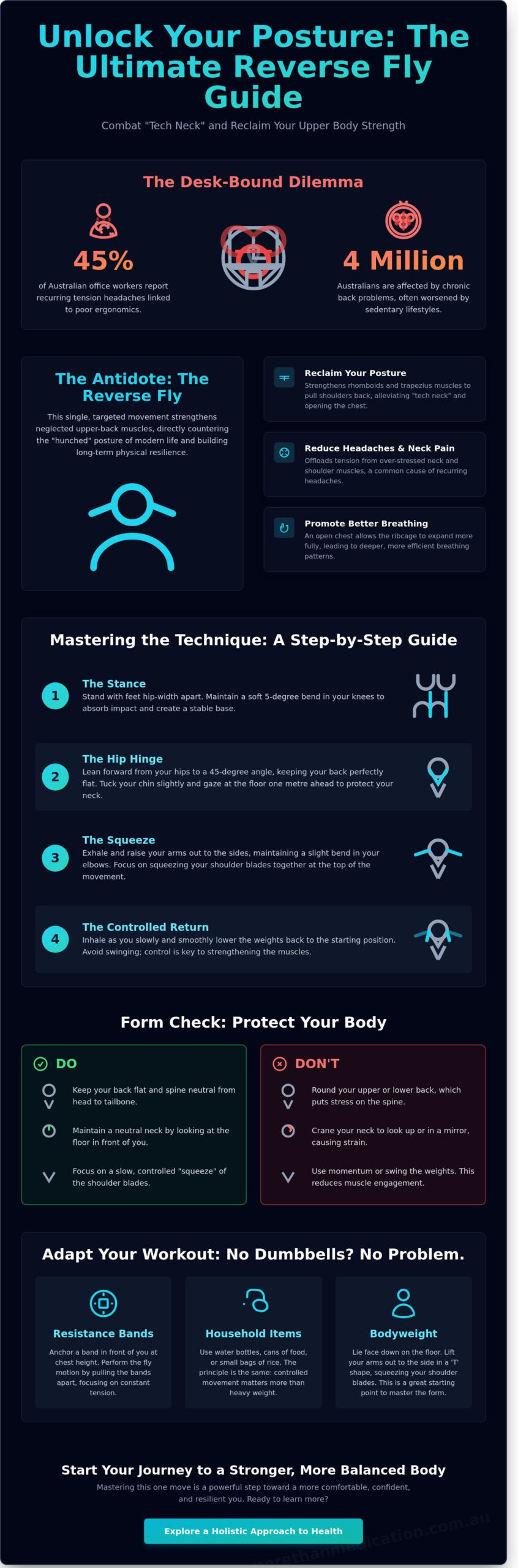
In 2026, the shift toward permanent hybrid work models in Australia has led to a rise in “tech neck” and postural fatigue. Recent health data indicates that approximately 45% of Australian office workers report recurring tension headaches linked to poor upper-body ergonomics. Strengthening the upper back through a reverse flies workout provides the structural integrity needed to resist this slump. It builds long-term physical resilience, ensuring that your body can handle the pressures of a digital-first career without sacrificing comfort.
- Reduces the frequency of tension-based headaches by offloading the neck muscles.
- Creates a stable base for other functional movements like lifting groceries or playing with children.
- Promotes better breathing patterns by allowing the ribcage to expand fully.
- Balances the “push-heavy” nature of many traditional gym programs.
Choosing to focus on these smaller, stabilizing muscles is a patient and wise investment in your future self. It bridges the gap between clinical rehabilitation—often supported by occupational health specialists like Persona Health—and everyday vitality, making your health journey feel more manageable and less like a chore. As you master this move, you’ll find that the benefits extend far beyond the gym, creating a sense of balance that radiates through every aspect of your life.
Mastering the Technique: Your Step-by-Step Reverse Fly Guide
Beginning a new strength routine is a brave step toward better health, but it’s natural to feel a little uncertain about your form. When you start your reverse flies workout, remember that your body deserves patience. You don’t need heavy weights to see results. In fact, many beginners find that starting with 1 or 2 kilogram dumbbells, or even just the weight of their own arms, allows them to master the movement without strain. This gentle approach ensures you’re building a foundation of safety before adding intensity.
The secret to a successful reverse fly lies in the hip hinge. By leaning forward at a 45-degree angle while keeping your back flat, you create a stable platform that protects your lumbar spine. It’s about the “squeeze” rather than the “swing.” Using momentum might feel easier, but a slow, controlled motion is what truly strengthens the muscles between your shoulder blades. Pair each movement with your breath; exhale as you lift to stay grounded and present in the moment.
The Perfect Setup
Stability begins at your feet. Place them hip-width apart with a soft, 5-degree bend in your knees to absorb impact and support your weight. Finding a neutral spine is your next priority. While it’s tempting to look in the mirror to check your form, cranking your neck upward can cause unnecessary tension. Instead, tuck your chin slightly and gaze at a spot on the floor about one metre in front of you. For your grip, you can choose to have your palms facing each other or facing backward. Both are effective, so choose the one that feels most natural for your shoulders today.
The Execution Phase
As you begin the lift, maintain a slight bend in your elbows. This small adjustment keeps the tension on your muscles and off your joints. Think of the movement as “opening your wings” and lead with your elbows rather than your hands. This Reverse fly with dumbbell technique ensures you are targeting the posterior deltoids effectively. When you reach the top of the arc, hold the position for 2 full seconds. This “stat-dense” pause forces your rhomboids to engage fully, making every repetition count toward your progress.
The Mind-Muscle Connection
To ensure your back is doing the heavy lifting rather than your arms, try to visualise your shoulder blades sliding together toward your spine. It’s a subtle internal shift that changes the entire dynamic of the reverse flies workout. Mindfulness is a powerful tool here; by staying focused on the sensation in your upper back, you reduce the risk of “shrugging” your shoulders toward your ears. This mental focus helps prevent the compensatory movements that often lead to neck stiffness. If you find your thoughts drifting, simply return to the rhythm of your breath and the feeling of your muscles working in harmony. Embracing mindful movement practices can transform a simple exercise into a moment of genuine self-care and resilience.
Common Pitfalls and How to Protect Your Wellbeing
It’s deeply frustrating to put in the effort only to feel the “burn” in the wrong place. If you finish your set feeling a pinch in your neck rather than a glow in your upper back, you aren’t alone. Many people starting a reverse flies workout find that their bodies instinctively try to make the movement easier by recruiting the wrong muscles. This isn’t a failure of your strength, but rather a common hurdle in the journey toward better posture and back health. Learning to listen to these physical cues is a vital part of building a mindful connection with your body.
One of the most frequent mistakes is using momentum to “swing” the weights. When you use a rocking motion, you rely on gravity and physics rather than muscle fibers. This habit doesn’t just stall your progress; it places unnecessary stress on your lower back. You should also learn to distinguish between “good” muscle fatigue and “bad” joint pain. A warm, heavy sensation in the muscles between your shoulder blades is a sign of growth. However, sharp, stabbing, or radiating pain in the shoulder joint or spine is your body’s way of asking you to stop and reassess.
The “Trap” of the Upper Traps
Most of us carry our daily stress in our shoulders, leading to a constant, subconscious shrug. When you perform this exercise, that tension can take over. Shrugging shifts the load from the back to the neck, increasing tension. To counter this, imagine your shoulder blades are sliding down into your back pockets. Keep your neck long and your gaze slightly ahead of your feet on the floor. This creates space for your rear deltoids to do the heavy lifting while keeping your cervical spine safe and relaxed.
Choosing the Right Load
The “ego lifting” trap is a significant barrier to a successful reverse flies workout. Because the muscles targeted are relatively small, they don’t require massive weights to see results. If you find your back rounding or your arms only moving halfway up, your weights are likely too heavy. Focus on quality over quantity to ensure you’re building resilience rather than just moving mass. A 2021 study on resistance training suggests that form-focused repetitions yield 15% better muscle activation than heavier, uncontrolled movements.
To progress safely, follow the “2-for-2” rule. If you can perform two extra repetitions beyond your goal in your final two sets for two consecutive workouts, it is time to increase the resistance. Usually, an increase of 0.5kg to 1kg is enough to challenge the body without compromising your alignment. This steady, patient approach ensures your physical journey remains sustainable and injury-free.
Adapting the Fly: Variations for Every Body and Space
Every person begins their fitness journey from a different starting line. You might be recovering from a minor injury, managing chronic discomfort, or simply working with a small living room space in an Australian apartment. Your reverse flies workout shouldn’t be a source of stress; it should be an adaptable tool that serves your specific needs. Finding the right variation is about listening to your body and respecting its current limits while gently pushing for growth and resilience.
We believe there’s no “one-size-fits-all” approach to movement. What works for a professional athlete might not be the best fit for someone looking to improve their posture after a long day at a desk. By exploring different equipment and positions, you can find a rhythm that feels supportive and effective for your unique circumstances.
The Seated Reverse Fly
For many people, the traditional bent-over position puts unwanted pressure on the lumbar spine. If you experience lower back concerns, the seated version offers a safer, more supportive alternative. Sit at the edge of a chair or bench and lean forward until your chest is supported by your thighs. This physical contact stabilises your torso, allowing you to focus entirely on the muscles between your shoulder blades. By taking your legs out of the equation, you create a pure isolation exercise that ensures your back does the work without the need to balance your entire body weight.
Resistance Band Variations
Resistance bands are a wonderful choice if you prefer a gentler approach to strength. Unlike dumbbells, which provide constant gravity-based tension, bands offer “ascending resistance.” This means the move gets harder as you reach the peak of the movement, which is often kinder to your shoulder joints. You can perform a “pull-apart” by holding the band in front of you and stretching it wide. Alternatively, anchor your band to a sturdy door handle to perform a standing fly. It’s a portable solution that fits easily into a travel bag or a kitchen drawer.
At-Home “No Equipment” Solutions
You don’t need a gym membership to build a resilient back. Everyday household items like 400g tins of beans or 600ml water bottles serve as effective weights for those just starting out. If you want to progress further, incorporating kettlebell training techniques can introduce a different centre of gravity that challenges your stability. For those seeking intensity without holding extra weight, wearing a weighted vest helps distribute the load across your torso. You can even try an “Isometric Fly” by pressing the backs of your hands against a doorframe for 15 seconds. This builds strength through pure tension, requiring no equipment at all.
Explore how More Than Medication can help you balance physical activity with your overall wellbeing.
Building a Sustainable Movement Practice
Your journey toward a stronger back isn’t a race to a finish line. It’s a lifelong practice of showing up for yourself with patience and kindness. We often view exercise as a chore or a quick fix for a specific ache, but true resilience comes from reframing these movements as essential acts of self-care. When you commit to a reverse flies workout, you’re doing more than just building muscle; you’re investing in your future mobility and daily comfort. This shift in perspective helps transform a routine into a rewarding ritual that supports your whole self.
A balanced upper body requires a blend of strength and flexibility. While reverse flies target those crucial posterior deltoids and rhomboids, pairing them with yoga for beginners creates a truly holistic routine. This combination helps release the tightness in the chest and shoulders that often accumulates from long hours spent at a desk or driving. At More Than Medication, we believe that movement is a fundamental pillar of health. While medicine provides essential support for many conditions, these daily physical choices empower you to take an active, hopeful role in your own wellbeing.
Frequency and Integration
You don’t need to spend hours in a gym to see meaningful results. Aim to include a reverse flies workout two to three times per week, allowing at least 48 hours between sessions for your muscles to recover. If a full workout feels overwhelming, try a “movement snack.” Perform 10 focused reps during your afternoon break or while waiting for the kettle to boil. These small, consistent efforts create lasting change. Consistency beats high-intensity bursts every time because it builds a sustainable habit rather than leading to burnout.
Listening to Your Body’s Wisdom
Your body is a wise communicator that tells you exactly what it needs if you pause to listen. Learn to distinguish between the healthy “burn” of muscle effort and the sharp, pinching warning of pain. If you feel deeply exhausted, honour that feeling with rest. Muscles don’t actually grow during the workout; they repair and strengthen while you sleep and nourish yourself with balanced meals. To learn more about supporting your recovery through high-quality supplements, Fantastic Nutrition offers expert insights on choosing the right products for your fitness goals.
Remember that you are more than your physical progress or the weight you can lift. Celebrate the small, quiet wins, such as noticing you’re sitting taller at your desk or feeling less tension in your neck after a long day. You’re on a path toward a more vibrant, balanced life, and every intentional movement is a step in the right direction. We are here to support you as you discover that health is a journey of the mind and body together.
Embrace the Power of Purposeful Movement
Integrating a reverse flies workout into your weekly routine is a gentle yet powerful way to reclaim your posture and support your spinal health. By focusing on the mind-muscle connection rather than just the weight, you’re building a foundation of resilience that serves you far beyond the gym. This practice helps counteract the forward-leaning habits of modern life, helping you stand taller and move with greater ease. Every repetition is a commitment to your future self and your long-term mobility.
The Australian Department of Health and Aged Care recommends muscle-strengthening activities at least two days a week for adults to improve long-term health outcomes. Our expert-led fitness advice is grounded in holistic health and evidence-based strategies specifically designed for Australian lifestyles. We believe wellbeing is about the whole person, and our supportive community is here to help you find the “more” in your health journey. We provide the steady guidance you need to navigate the ups and downs of physical activity with confidence and care.
Explore our comprehensive fitness pillar to find more ways to move with purpose and joy. You’ve got the tools to succeed, and we’re with you every step of the way.
Frequently Asked Questions
Is the reverse fly workout safe for people with lower back pain?
Yes, the reverse flies workout is safe if you use a chest-supported bench to remove strain from your spine. About 4 million Australians live with chronic back issues according to 2024 AIHW reports. If standing feels painful, sitting or lying face down on an incline bench provides the stability you need. This modification protects your lumbar region while allowing you to build upper body resilience without discomfort.
Can I do reverse flies every day to fix my posture faster?
You should avoid doing this exercise every day because your muscles need 48 hours to repair and grow stronger. Rest is just as important as the movement itself in your journey toward better posture. Aim for 2 to 3 sessions per week to see results without risking overuse injuries. Giving your body this space helps you stay consistent and prevents the burnout that often stops progress.
What is the best weight to start with for a reverse fly?
Most beginners should start with 1kg to 2kg dumbbells to ensure they maintain perfect form. It’s common to feel like you should lift more, but these smaller muscle groups respond best to controlled, steady movements. Focusing on the quality of the squeeze rather than the heavy load protects your joints. As you feel more confident, you can gradually increase the weight by 0.5kg increments as your strength improves.
Why do I feel the reverse fly more in my neck than my back?
You likely feel tension in your neck because your upper trapezius muscles are taking over the movement. This often happens when the weight is too heavy or if you’re shrugging your shoulders toward your ears. Try to keep your shoulders tucked down and away from your neck throughout the lift. Visualising your shoulder blades sliding into your back pockets can help redirect the effort to your rear deltoids.
What is the difference between a reverse fly and a bent-over row?
A reverse fly isolates the rear deltoids and rhomboids using a wide, arc-like motion, while a bent-over row is a compound movement that involves pulling the weight straight up. Rows allow you to lift heavier loads because they engage the larger latissimus dorsi muscles. The reverse flies workout specifically targets the smaller muscles that help pull your shoulders back. Using both exercises creates a balanced approach to your physical wellbeing.
Can I do reverse flies without any equipment at all?
You can absolutely perform this move without professional gym gear by using 500ml water bottles or simply your own arm weight. Focus on the mind-muscle connection by squeezing your shoulder blades together for 3 seconds at the top of each rep. This isometric hold creates tension even without heavy resistance. It’s a great way to practice the movement pattern in the comfort of your own home while building confidence.
How many reps and sets should a beginner perform?
Beginners should aim for 2 to 3 sets of 10 to 15 repetitions to build a solid foundation of muscle memory. This range prioritises endurance and form over raw power, which is safer for your connective tissues. If you find your form slipping by the 8th rep, it’s okay to stop and rest. Your progress is a personal journey, and listening to these small signals from your body is a sign of true strength.
Should I do reverse flies before or after other back exercises?
You should generally perform these after your heavier compound lifts like rows or pull-downs. Since reverse flies target smaller, specific muscles, you don’t want to fatigue them before you tackle the bigger movements that require their support. Saving them for the end of your session ensures you can give them your full focus. This sequence helps you maintain a balanced energy level throughout your entire workout routine.
⚕️ Medical Disclaimer
This content is for informational purposes only and is not a substitute for professional medical advice, diagnosis, or treatment. Always seek the advice of your doctor or other qualified health provider with any questions you may have regarding a medical condition. Never disregard professional medical advice or delay in seeking it because of something you have read on this website.