
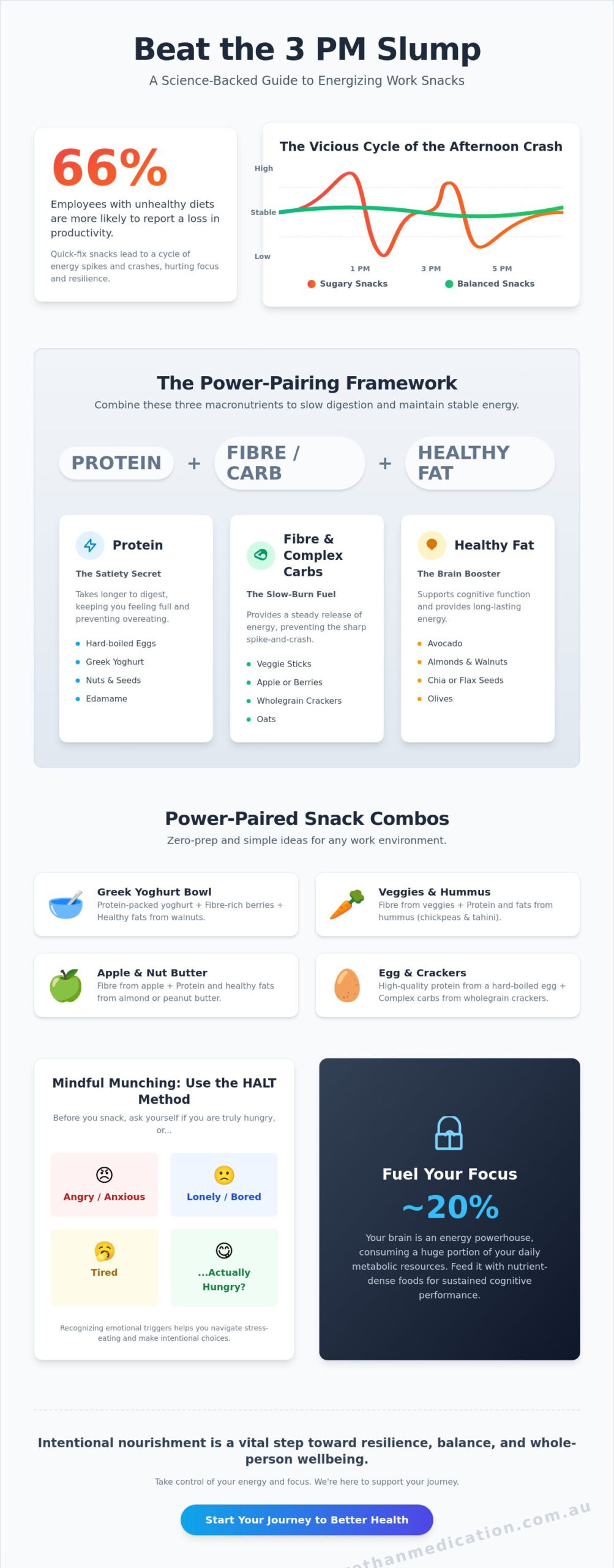
Did you know that employees with unhealthy diets are 66% more likely to report a loss in productivity? It is a staggering figure that highlights how the food we reach for at 3 PM does more than just quiet a rumbling stomach; it dictates the quality of our focus and our resilience against stress. You’re likely familiar with that heavy afternoon fog where decision fatigue sets in and the nearest shop feels like the only solution. It’s exhausting to constantly choose between what’s quick and what’s actually good for your body, especially while navigating a busy Australian work week.
We want to help you reclaim your energy by moving beyond mindless grazing toward intentional, science-backed nourishment. Because health is always about more than just a quick fix, we’re here to support your journey toward better balance and help you feel empowered by your choices. This guide explores healthy snack ideas for work that align with the new 2025-2030 Dietary Guidelines released in January 2026. We’ll show you how to prioritize high-protein, minimally processed “real food” to maintain stable energy and sharp cognitive focus through simple, delicious recipes.
Key Takeaways
- Understand the biological triggers behind the 3 PM slump and learn how to stabilize your blood glucose for consistent mental clarity.
- Master the “Power-Pairing” framework to create healthy snack ideas for work that combine protein, fiber, and healthy fats for lasting satiety.
- Discover over 20 practical snack options tailored to your schedule, including zero-prep desk essentials and simple batch-cook recipes.
- Learn the HALT method to better understand your body’s signals, helping you navigate office treat culture and stress-eating with confidence.
- See how intentional nourishment acts as a vital step in your broader journey toward resilience, balance, and whole-person wellbeing.
The Science of the 3 PM Slump: Why Your Brain Craves Snacks
You’ve felt it before. The clock hits three, and suddenly, that complex report feels impossible to finish. This isn’t a lack of willpower; it’s biology. Our bodies follow a natural circadian rhythm that often dips in the mid-afternoon, leading to a temporary lull in alertness. During this window, your brain’s ability to make high-level decisions takes a hit, making you more susceptible to distractions and quick-fix cravings.
When your blood sugar drops, your brain sends out an urgent signal for immediate energy. This is why you often crave “quick fix” processed sugars like lollies or biscuits. These refined carbohydrates cause a sharp insulin spike followed by an inevitable crash, leaving you more fatigued than when you started. Understanding the Science of Snacking helps us see that choosing the right fuel is a form of self-care that protects your focus.
There is also a powerful link between your gut health and your mental clarity. A busy workday can be taxing on your digestive system, and if your gut is struggling with highly processed foods, it can’t efficiently produce the neurotransmitters needed for a stable mood. Proactive healthy snack ideas for work focus on whole foods that support this gut-brain connection, ensuring your mind stays resilient through the final hours of the day.
At More Than Medication, we believe health is about the whole person. Snacking isn’t just about stopping a growling stomach; it’s a strategic tool for maintaining your emotional resilience and cognitive endurance. It’s about giving your body the information it needs to thrive, not just survive the afternoon.
Glucose and the Cognitive Connection
Stable blood sugar levels provide the steady stream of fuel required by your prefrontal cortex to manage focus and impulse control. While your brain accounts for only about 2% of your body weight, it consumes roughly 20% of your daily metabolic energy. High-intensity “brain work” is physically demanding and requires significant metabolic resources. If you feed it “empty” energy, the fuel burns out too fast. Sustained fuel comes from nutrient-dense choices that release energy slowly into your bloodstream.
The Psychology of Workplace Cravings
It’s vital to recognize that you aren’t always physically hungry; sometimes, you’re “stress-hungry.” High-stakes meetings or periods of boredom can trigger a desire for a sensory distraction. Common office triggers, like the “communal kitchen” effect, often lead to mindless eating. Before you reach for a snack, try a mindful check-in to see if you’re actually tired or overwhelmed. Having a few healthy snack ideas for work ready at your desk helps you bypass these triggers and choose what truly nourishes you.
The Power-Pairing Framework: Building Snacks That Last
Choosing the right healthy snack ideas for work shouldn’t be a source of stress. It’s about a simple, reliable formula that protects your energy levels throughout the day. Instead of grabbing a lone piece of fruit or a handful of crackers, we recommend the Power-Pairing framework: Protein + Complex Carbohydrate/Fibre + Healthy Fat. This combination is a strategic way to slow down your digestion. By buffering the release of sugar into your bloodstream, you stay well within the recommended limit of 10 grams of added sugar per meal as outlined in the 2025-2030 Dietary Guidelines. This prevents the sharp insulin spike and subsequent crash that leaves you feeling drained by 4 PM.
This approach aligns with the latest health trends in 2026, which emphasize functional foods that do more than just fill a gap. They act as vital information for your cells. Before you reach for food, remember that your brain often confuses thirst with hunger. A glass of water might be the actual “snack” your body is asking for. If you’re looking for inspiration for your next team gathering, these Healthy Office Snacks provide a great starting point for collective wellbeing.
Protein: The Satiety Secret
Protein is the anchor of any high-performance snack. It takes longer to break down, keeping you fuller for much longer. For a quick office fix, try keeping hard-boiled eggs in the fridge or a small tub of Greek yoghurt. Australian professionals are also increasingly turning to lupin flakes as a high-protein, low-carb addition to snacks. If you’re following a plant-based diet, roasted chickpeas or a serve of edamame are excellent ways to hit your protein goals while staying focused at your desk.
Fibre: The Slow-Release Engine
Fibre acts as the slow-release engine for your energy. Wholegrains and raw vegetables don’t just provide a satisfying crunch; they feed your gut microbiome. Since your gut and mood are closely linked, high-fibre choices help maintain emotional balance during a high-pressure day. Look for AU-standard wholegrain crackers or local seeds like sunflower and pumpkin. These small choices are part of a larger journey toward a more balanced lifestyle. If you’re feeling overwhelmed by the options, you can always explore more expert advice on nutrition to find what fits your unique needs.
20+ Nutritious Snack Ideas for Every Work Environment
Your environment often dictates your choices, but it doesn’t have to limit your health. Finding the right healthy snack ideas for work depends on your daily rhythm. Whether you are tethered to a desk or moving between site visits, your nutrition should adapt to your needs. Choosing Australian seasonal produce ensures you get the highest nutrient density. It is also a budget-friendly way to shop as prices for fresh fruit and vegetables fluctuate. By stocking your desk or bag with intentional fuel, you reduce the anxiety of mid-afternoon decision fatigue.
For those who prefer a “Sunday Reset,” batch-cooking is a powerful tool for resilience. Taking an hour to prepare healthy slice recipes ensures you have a reliable supply of whole-food snacks for the entire week. This small act of preparation is a compassionate gift to your future self, making your health journey feel much more manageable and less like a chore.
The Desk-Bound Professional (Low Mess, High Focus)
For the desk-bound professional, low-mess options are essential for maintaining focus. Dry-roasted chickpeas seasoned with Australian bush spices provide a satisfying crunch without the grease of traditional chips. Apple slices paired with almond butter help you reach the daily goal of two fruit servings while providing the protein anchor we discussed earlier. Air-popped popcorn seasoned with nutritional yeast offers a savory flavor and a helpful B-vitamin boost for your nervous system.
The On-the-Go Worker (Portable and Durable)
If your day involves travel or site visits, portability is key. Homemade energy balls made from dates and nuts are durable and provide a quick energy lift. Bento-style boxes filled with colorful veggie sticks and hummus offer a refreshing, high-fiber break between appointments. We also recommend pre-portioned nut and seed mixes. These are excellent for heart health, especially when you practice Mindful Eating at Work to avoid over-consuming these calorie-dense powerhouses.
The “Elevated” Office Snack (Fridge Required)
When you have access to a fridge, your options for healthy snack ideas for work expand significantly. Chia seed pudding topped with seasonal berries provides a cooling, fiber-rich treat that feels indulgent but remains nutrient-dense. Cottage cheese on wholegrain crispbread with sliced tomato offers a high-protein snack that keeps you full until dinner. For a brain-boosting option, try smoked salmon and cucumber “boats.” The Omega-3 fatty acids in the salmon support cognitive function during demanding tasks, helping you stay sharp when it matters most.
Mindful Munching: Navigating Stress and the Office Treat Culture
The office kitchen often feels like a social hub where “social contagion” can influence your dietary choices. When a colleague brings in a tray of doughnuts to celebrate a win, the pressure to join in isn’t just about the food; it’s about belonging. It’s completely natural to feel a sense of conflict between your health goals and the desire to be part of the team. We want to reassure you that managing these moments is a skill that grows with time and self-compassion. Choosing healthy snack ideas for work is a wonderful foundation, but learning to navigate the emotional landscape of the workplace is what makes those choices sustainable.
Before reaching for a communal treat, try using the “HALT” method to check in with your emotional state. Ask yourself if you are truly Hungry, or if you are actually feeling Angry, Lonely, or Tired. Often, a mid-morning craving is actually a signal that you need a five-minute break or a quick chat with a friend to ease feelings of isolation. If you find yourself in a catered meeting, try reaching for the fruit platter or the raw nuts first. Filling up on these nutrient-dense options makes it much easier to enjoy a smaller portion of a “treat” without the subsequent energy crash. Remember, one indulgent snack is never a failure. It is simply one part of a balanced lifestyle that prioritizes your overall wellbeing over perfection.
The Art of the Gentle “No”
Declining a communal treat doesn’t have to be awkward or isolating. You can maintain rapport with your team while staying true to your journey. Try a simple script like, “That looks delicious, but I’ve actually just finished my snack and I’m quite full!” or “I’ll pass for now, but thank you so much for thinking of me.” At More Than Medication, we believe in finding joy in connection rather than just food. You might also consider leading by example. Bringing a platter of seasonal Australian fruit or roasted chickpeas to share can shift the office culture toward more supportive, inclusive habits.
Recovering from the Sugar Crash
If you do overindulge, the most important step is to let go of the “all-or-nothing” mentality. Guilt often leads to further stress-eating, which only prolongs the slump. Instead, focus on a gentle reset. Drink a large glass of water and take a ten-minute walk around the block to help your body process the sugar and clear your mind. Self-compassion is your most powerful tool for long-term health adherence. If you need more support in managing the intersection of your physical and mental health, you can find expert advice on living a balanced lifestyle through our community resources.
The More Than Medication Approach: Integrating Snacks into Your Journey
Your health is a continuous journey, not a destination reached through a single choice. While professional medical advice and treatments provide a vital foundation, the small, rhythmic decisions you make at your desk each day are the “more” that completes the puzzle. Viewing your food as information for your cells rather than just a way to stop hunger transforms the way you work. When you choose healthy snack ideas for work, you are providing your body with the fuel it needs to support your professional ambitions and your emotional resilience. It’s a partnership between the care you receive from health professionals and the compassionate choices you make for yourself every afternoon.
We encourage you to see these dietary adjustments as a gentle act of self-care. By aligning your habits with the 2025-2030 Dietary Guidelines, you are taking proactive steps to reduce the risk of burnout and fatigue. Start with one small change this week. Perhaps it’s replacing one processed snack with a whole-food alternative or simply drinking an extra glass of water before your mid-afternoon break. These tiny shifts accumulate, creating a sense of progress and hope that carries you through even the most demanding work cycles.
Preparation: The Ultimate Tool for Resilience
Resilience often grows from the quiet moments of preparation. Spending twenty minutes on a Sunday evening to portion out nuts or wash seasonal vegetables can significantly reduce your decision fatigue during the week. We recommend stocking a “wellness kit” in your desk drawer—or your work vehicle if you’re in the field using professional-grade equipment from J Racenstein—with non-perishable essentials like pumpkin seeds, tinned tuna, or lupin flakes. When you are at the shop, use the Australian Health Star Rating as a quick guide to compare packaged options. Aiming for products with higher ratings ensures you are staying within the recommended limits for sodium and added sugars, making your healthy snack ideas for work both simple and effective.
Your Next Steps to Holistic Wellbeing
Nourishing your body is just one piece of a balanced lifestyle. As you become more mindful of how food impacts your focus, you might feel inspired to explore other areas of wellbeing, such as intentional movement or mental health practices. Physical recovery is also a key component of staying resilient in a high-pressure environment. You can explore our Remedial Massage guide for targeted tips on healing and recovery to complement your nutritional efforts. Remember, you have the power to fuel your best self. We are here to walk alongside you as you navigate this journey toward a more vibrant and balanced life.
Nourishing Your Potential One Choice at a Time
Transforming your energy levels isn’t about an overnight overhaul; it’s about the small, intentional acts of kindness you show yourself during the work week. By mastering the power-pairing framework and using the HALT method to understand your body’s true signals, you can move past the afternoon fog with confidence. These healthy snack ideas for work are more than just food. They are a practical way to protect your mental clarity and build the resilience needed to thrive in a demanding professional landscape. You don’t have to navigate this journey alone, and every small change you make today builds a stronger foundation for tomorrow.
At More Than Medication, we provide expert-led health advice that bridges the gap between clinical care and daily lifestyle choices. Our holistic approach to physical and mental wellbeing is designed to empower Australians to live balanced, vibrant lives. We invite you to Explore our full guide to holistic nutrition and wellness to find more ways to support your unique health journey. You have the power to fuel your best self, and we are honored to be a steady presence by your side as you do.
Frequently Asked Questions
How can I stop mindless snacking when I am stressed at my desk?
You can break the cycle of mindless snacking by pausing for a sensory check-in before you reach for food. Stress often triggers a desire for a “quick fix” distraction, so try drinking a glass of water or taking ten deep breaths to reset your nervous system first. If you still feel a physical need for nourishment, choose one of your pre-planned healthy snack ideas for work to ensure you’re responding to your body’s needs rather than just an emotional urge. This small pause empowers you to regain control over your choices during a high-pressure day.
What are the best non-perishable healthy snacks to keep in my drawer?
The best shelf-stable options focus on the power-pairing of protein and fibre to keep you satisfied without refrigeration. We recommend keeping a “wellness kit” stocked with raw almonds, pumpkin seeds, dry-roasted chickpeas, and tinned tuna or salmon. Lupin flakes are also a fantastic Australian staple that you can stir into a quick office pantry bowl. These items provide a reliable safety net for those days when meetings run late and you can’t get to the fridge or a shop.
Is it better to eat three big meals or small snacks throughout the day?
There isn’t a one-size-fits-all answer, but maintaining a steady rhythm of fuel can prevent the blood glucose dips that lead to brain fog. For many professionals, eating smaller, nutrient-dense snacks between main meals helps regulate energy and prevents overeating at dinner. The key is to listen to your body’s unique hunger cues and ensure every eating occasion includes whole, minimally processed foods. Finding a balance that supports your focus is a vital part of your personal health journey.
How much protein should my afternoon snack actually contain?
Aiming for 15 to 20 grams of protein in your afternoon snack is a great way to support satiety and muscle maintenance. Since the 2025-2030 Dietary Guidelines increased the recommended daily protein allowance, prioritizing this “powerhouse” nutrient helps you stay full until your next meal. You can easily reach this target with a serve of Greek yoghurt, a couple of hard-boiled eggs, or a handful of roasted broad beans. Protein acts as the anchor for your energy, preventing the common sugar crash associated with refined carbohydrates.
What are some low-sugar alternatives for when I have a sweet craving at work?
You can satisfy a sweet craving by choosing “real food” options that contain less than 10 grams of added sugar per serve. Fresh seasonal berries paired with a few walnuts or a square of 85% dark chocolate provide a satisfying flavor without the insulin spike. Cinnamon is also a wonderful tool for naturally sweetening snacks like plain yoghurt or sliced pears. These choices align with the latest federal nutrition policy to reduce highly processed sugars while still providing a pleasant sensory experience.
Can healthy snacks really improve my productivity and focus?
Yes, research shows that employees with unhealthy diets are 66% more likely to report a loss in productivity. By choosing healthy snack ideas for work that stabilize your blood sugar, you provide your prefrontal cortex with a steady stream of fuel for complex decision-making. Consistent nourishment reduces the mental fatigue that often leads to errors and procrastination in the late afternoon. Investing in your nutrition is a direct investment in your professional resilience and cognitive endurance.
What should I look for on Australian food labels when buying office snacks?
Look for products with a high Australian Health Star Rating and prioritize items with simple, transparent ingredient lists. You should check the nutrition information panel to ensure the snack contains less than 10 grams of added sugar and a manageable amount of sodium, ideally staying well under the 2,300 mg daily limit. Avoid snacks that list refined flours or vegetable oils as the first few ingredients. Choosing minimally processed options is a manageable way to navigate the shop without feeling overwhelmed by complex labels.
How do I handle office “treat culture” without being the “health police”?
You can navigate shared treats by focusing on connection and conversation rather than the food itself. It’s perfectly okay to decline a treat with a warm, appreciative smile, or you can choose to have a small portion and pair it with a piece of fruit to slow the sugar absorption. Leading by example is another powerful strategy. Bringing in a colorful platter of seasonal fruit or savory roasted seeds to share shows your colleagues that nourishment can be both delicious and inclusive without any judgment.
⚕️ Medical Disclaimer
This content is for informational purposes only and is not a substitute for professional medical advice, diagnosis, or treatment. Always seek the advice of your doctor or other qualified health provider with any questions you may have regarding a medical condition. Never disregard professional medical advice or delay in seeking it because of something you have read on this website.