
Did you know that between 80% and 90% of Australian women will experience cellulite at some point in their lives? Despite how common it is, the beauty industry often treats this natural skin texture like a problem that needs solving. You’ve likely felt the sting of disappointment after spending A$50 on a “miracle” firming cream from the local chemist, only to see zero change in the mirror. It’s exhausting to feel like you’re fighting a losing battle against your own biology while trying to meet an impossible standard of smoothness.
We agree that the endless cycle of “fixing” and “hiding” is draining your energy and your wallet. That’s why we’re shifting the focus from perfection to a compassionate partnership with your body. In this guide, you’ll discover the biological reality of how your skin functions and learn which lifestyle shifts actually support long-term elasticity and health. We’ll explore the science-backed habits that foster resilience, helping you move from a place of anxiety to one of informed empowerment. It’s time to understand the “more” in your health journey, starting with the honest truth about your skin.
Key Takeaways
- Understand that dimpled skin is a natural biological reality for the vast majority of women, driven by hormones rather than personal habits.
- Learn how to navigate the complex world of skin treatments by distinguishing between temporary fads and evidence-based options available in Australia.
- Discover how simple, holistic shifts in movement and nutrition can nurture your skin’s health and support your body’s natural resilience.
- Uncover the science-based truth about cellulite to help you transition from feelings of shame toward a more empowered state of body neutrality.
- Embrace a journey that looks beyond the surface, focusing on the vital intersection of physical health and emotional wellbeing.
What is Cellulite? Normalising the ‘Orange Peel’ Texture
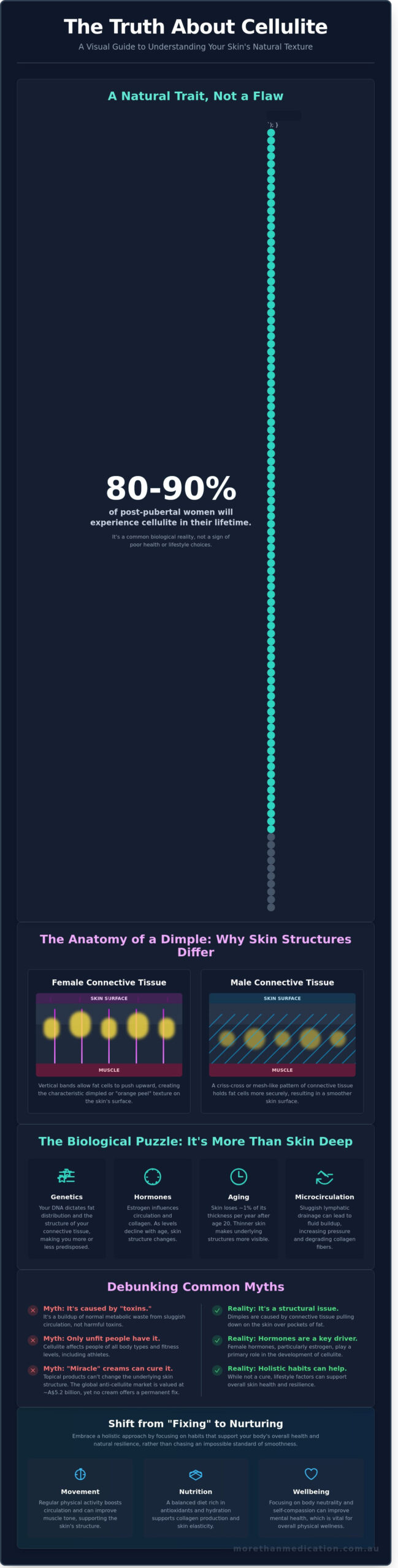
If you’ve ever noticed a dimpled, uneven texture on your thighs or hips, you’re in the vast majority. Cellulite is a harmless skin feature that affects between 80% and 90% of women at some point in their lives. Despite what airbrushed advertisements suggest, these ripples aren’t a sign of poor health or a lack of discipline. They are simply a result of how our bodies are built. We often feel an immense pressure to fix what is actually a standard biological trait. At More Than Medication, we believe your worth isn’t defined by the smoothness of your skin. This journey is about understanding your body and finding a balance that makes you feel confident and cared for.
The Anatomy of a Dimple
Think of your skin like a quilted mattress. Beneath the surface, you have fat cells cushioned between the dermis and deeper muscle. Tough bands of connective tissue, called septae, tether your skin to the underlying muscle like the buttons on a mattress. When fat cells push upward while these cords pull downward, the characteristic dimpling of cellulite appears. Calling this a “condition” is technically a misnomer; it is a structural arrangement of tissue. In a 2015 study published in the Journal of Cosmetic and Laser Therapy, researchers emphasized that these structural variations are entirely normal across all body types.
Why Women Are More Likely to Have Cellulite
Biology plays a significant role in why men rarely experience these dimples. In men, connective tissue usually forms a sturdy, criss-cross pattern that keeps fat tucked away. Women generally have vertical bands, which make it easier for fat to peek through. As we age, our skin naturally loses collagen and elasticity, often making the texture more visible. This doesn’t mean your health is declining. In fact, a woman with a low Body Mass Index (BMI) can have more visible cellulite than someone with a higher weight. It’s about the architecture of your skin, not just the numbers on a scale. Your body is a complex system where physical traits and mental wellbeing intersect. Medicine is just one tool; self-compassion is another.
The Biological Puzzle: What Actually Causes Cellulite?
You’ve likely heard that cellulite is a sign of being “out of shape,” but science tells a much kinder, more complex story. It isn’t a reflection of your lifestyle choices or a lack of discipline. Research published in the Journal of Cosmetic and Laser Therapy indicates that between 80% and 90% of post-pubertal women will experience these skin changes. It is a biological reality shaped by your DNA. Genetics dictate how your body distributes fat and the specific pattern of your connective tissue; this means some people are simply more predisposed to these textures than others. Understanding this helps shift the focus from “fixing” a flaw to supporting your body’s natural architecture.
Hormones, Aging, and Skin Structure
Your hormones act as the primary architects of your skin’s internal landscape. Estrogen levels naturally fluctuate throughout your life, particularly during the transition to menopause. When estrogen levels begin to decline, blood vessels in the skin lose some of their elasticity, which can reduce vital circulation and collagen production. Adipocytes swell and put pressure on the surrounding fascia, creating that familiar dimpled effect. This process is compounded by the fact that skin loses approximately 1% of its thickness every year after age 20. As your skin thins over time, the underlying structures and fat cells become more visible to the naked eye.
The Role of Microcirculation
Your lymphatic system acts as a quiet drainage network for your body. When this system becomes sluggish, fluid builds up in the spaces between your cells, leading to visible swelling. This creates a challenging feedback loop: excess fluid increases pressure on the tissues, which leads to less oxygen reaching the area. Without adequate oxygen, the collagen fibres that keep your skin firm begin to degrade and lose their bounce. While many marketing campaigns blame “toxins” for these ripples, it’s actually a buildup of metabolic waste products in the interstitial fluid. Focusing on your overall physical wellbeing can help support these internal systems, reminding us that health is always about the whole person rather than just a single symptom.
Myth vs. Reality: Debunking the Most Common Cellulite Fads
You’ve likely seen the glossy ads promising a “cure” for cellulite in a bottle or a brush. The global anti-cellulite market reached a valuation of approximately A$5.2 billion in 2023, fueled by the deep-seated desire many of us feel to change our skin texture. It’s vital to remember that medicine is only one part of your health journey. Most products marketed to “erase” dimples focus on the surface, while the real structural changes happen deep within your connective tissue. Spotting “wellness-washing” is your first line of defense. If a product claims to “melt fat” or “flush out toxins,” it’s likely ignoring the biological reality of how your body functions.
To put that valuation into perspective, it’s worth noting how other global industries are growing; for instance, you can learn more about the surging valuations in Brazilian sports. This comparison highlights the significant financial engine driving the beauty and wellness market.
The Truth About Creams and Brushing
Topical treatments often provide a temporary confidence boost, but they don’t alter the underlying causes of cellulite. Caffeine-infused lotions work by temporarily dehydrating fat cells and constricting blood vessels, which can make skin look smoother for about four to six hours. Retinol creams are a longer game. A 2015 study showed that applying 0.3% retinol twice daily for six months can slightly thicken the dermis, making dimples less visible. However, these effects stop the moment you stop the routine.
- Dry Brushing: This ritual is wonderful for exfoliation and stimulating lymphatic drainage, but it cannot “break up” the fibrous bands that cause dimpling.
- Toxin Myths: Your liver and kidneys handle detoxification. Cellulite isn’t a collection of “trapped toxins” that you can sweat or scrub away.
- Body Wraps: These usually result in temporary water loss, providing a slimmer appearance that lasts only a day or two.
In-Clinic Procedures: What Does the Science Say?
If you’re looking for more noticeable changes, clinical interventions offer varying degrees of success. Subcision, often branded as Cellfina, is a TGA-approved procedure in Australia where a small needle releases the fibrous bands under the skin. It’s one of the few options with long-term data, showing results that can last up to three years. In Australian clinics, this procedure typically costs between A$3,500 and A$6,000 depending on the size of the treatment area.
Laser treatments and acoustic wave therapy (AWT) are less invasive but require more maintenance. AWT uses pressure waves to stimulate collagen, usually requiring 6 to 12 sessions at roughly A$150 to A$300 per visit. Results for these treatments often peak at the six-month mark and fade without yearly “top-up” sessions. No matter which path you choose, these procedures work best when supported by the holistic lifestyle habits we’ll explore in the next section.
Managing Cellulite Holistically: Fitness, Food, and Lifestyle
Your skin is your body’s largest organ, and it deserves more than just a surface-level fix. Rather than focusing on “erasing” cellulite, we can shift our energy toward supporting the structural health of our tissues. This holistic approach focuses on resilience and balance, acknowledging that skin texture is often a reflection of internal vitality. By reducing systemic inflammation, which a 2019 study published in the Journal of Clinical Medicine linked to compromised skin integrity, you can help your skin maintain its natural firmness over time. It’s about partnership with your body, not a battle against it.
Movement for Structural Support
Strength training offers a more effective path to skin smoothness than traditional cardio alone. While running or cycling improves heart health, lifting weights builds the muscle density needed to provide a firm scaffold beneath the skin. When you increase lean muscle mass by even 1 or 2 kilograms, it helps fill out the area, creating a smoother foundation that reduces the appearance of dimpling. Gentle activities like a 30-minute daily walk or yoga are also vital for your journey. These movements act as a pump for your lymphatic system, which lacks its own heart; this helps move fluid and reduce the puffiness that can make cellulite look more pronounced.
Nutrition for Connective Tissue
What you eat directly influences the “glue” that holds your skin together. Collagen synthesis requires a steady supply of Vitamin C and specific amino acids like proline and glycine. You should also focus on anti-inflammatory fats, such as the omega-3s found in oily fish or flaxseeds, to keep cell membranes supple. Be cautious of crash dieting or rapid weight loss plans. Research indicates that dropping weight too quickly can lead to a 25% decrease in skin elasticity, often making skin appear thinner and less resilient. Staying hydrated is equally essential; even a 2% drop in body water can affect skin turgor and clarity. Small, sustainable changes in your kitchen create the building blocks for long-term skin health.
You don’t have to navigate these lifestyle shifts alone. Discover how you can start balancing your physical and mental wellbeing with our supportive, evidence-based resources.
Embracing the Journey: Confidence Beyond the Surface
You have explored the biology of your skin and the various treatments available. Now, it’s time to focus on the person living inside that skin. At More Than Medication, we believe true health is more than a physical attribute or a smooth silhouette. It’s a reflection of how you feel in your daily life. While clinical options exist, your worth isn’t defined by the presence or absence of cellulite. Shifting your perspective from body shame to body neutrality can be the most transformative step in your wellness journey.
The Connection Between Mind and Body
Chronic stress does more than just cloud your mood; it actively changes your physiology. When you’re constantly stressed, your body releases higher levels of cortisol. Research, including studies published in Brain, Behavior, and Immunity, suggests that elevated cortisol can degrade collagen and hinder the skin’s ability to repair its own structural proteins. This means that self-compassion is actually a biological necessity.
Try focusing on body functionalism. Instead of critiquing a dimple, acknowledge that your legs allow you to walk through the local park or keep up with your family. Your body is a hardworking vessel for your experiences. When you treat yourself with kindness, you’re supporting your skin’s resilience from the inside out.
Practical Steps for Body Confidence
Building confidence is a practice that requires small, intentional shifts in your environment and internal dialogue. You can start today with these manageable steps:
- Audit your digital space: Unfollow social media accounts that promote “flawless” filtered skin. Seeing realistic, unfiltered bodies helps recalibrate your expectations.
- Reframe the narrative: View cellulite as a natural marker of a life lived. It’s a common trait shared by approximately 90 percent of women, making it a standard part of human biology rather than a flaw.
- Aim for neutrality: On days when “loving” your body feels out of reach, aim for neutral respect. Your skin protects you from the harsh Australian sun and regulates your temperature. That is a remarkable feat.
You are more than the texture of your skin. While science offers tools to manage the physical aspects of your body, your value remains unchanged by any topical treatment. You’re a whole person, and your journey is about finding balance, resilience, and peace in the skin you’re in.
Embrace Your Body with Evidence-Based Confidence
Understanding the biology of your skin is the first step toward a more compassionate relationship with yourself. Clinical research shows that cellulite affects between 80 and 90 percent of women after puberty, confirming it’s a standard biological trait rather than a flaw to be fixed. By shifting your focus from expensive fads to holistic habits like resistance training and balanced nutrition, you reclaim control over your daily wellbeing. It’s about finding a sustainable rhythm that supports your physical strength and your mental peace. Your health journey is unique, and you don’t have to navigate these changes alone.
We’re here to help you bridge the gap between clinical facts and the reality of daily life. Our expert-led content and evidence-based health trends provide the clarity you need to feel empowered. Join our supportive community for holistic living and discover why health is always about more than just a single diagnosis. Explore more expert-led wellness insights on More Than Medication. You’ve got the knowledge to move forward; now, take the next step with kindness and steady confidence.
Frequently Asked Questions
Can men get cellulite, or is it only a women’s health issue?
Yes, men can develop cellulite, though it affects only about 10% of the male population compared to nearly 90% of women. The difference lies in how your body stores fat and connective tissue; men usually have a criss-cross structure that keeps fat cells in place. In women, these fibers run vertically, allowing fat to bulge through. It’s a natural part of human biology and doesn’t define your health or worth.
Does drinking more water actually help get rid of cellulite?
Hydration won’t make the dimpling disappear instantly, but drinking the recommended 2.1 to 2.6 litres of water daily supports your skin’s structural integrity. Dehydrated skin becomes thinner and loses its bounce, making the underlying fat cells more visible. While water is a vital part of your holistic journey, it works best alongside a balanced lifestyle. Think of it as nourishing your skin from the inside out to improve overall texture.
Will losing weight make my cellulite disappear completely?
Losing weight may reduce the prominence of cellulite, but it rarely makes it vanish completely. Even individuals with a low Body Mass Index (BMI) of 18.5 often have visible dimpling because this is about skin structure, not just fat volume. Rapid weight loss can sometimes leave skin lax, which might actually emphasize the texture. Focus on gentle, sustainable habits that make you feel strong rather than chasing a “perfect” surface.
Is there a specific exercise that targets cellulite on the thighs?
There isn’t a single exercise that targets the dimpling specifically, but building muscle in your lower body can create a smoother foundation. Incorporating squats or lunges three times a week helps tone the quadriceps and hamstrings. While you can’t “burn” fat from just one area, increasing your muscle mass can improve the way skin sits over the tissue. It’s about feeling capable and resilient in your own body as you move.
Are expensive ‘anti-cellulite’ leggings worth the investment?
Most compression garments, which can cost upwards of A$120 in Australian retail stores, provide only a temporary smoothing effect. There’s no clinical evidence from regulatory bodies suggesting these garments permanently alter fat cells or connective tissue. They might boost your confidence during a workout, but they aren’t a long-term cure. Save your money for experiences or nourishing foods that support your wellbeing in a more meaningful, lasting way.
At what age does cellulite usually start to appear?
These skin changes typically begin to appear after puberty, with many Australians noticing them between the ages of 25 and 35. As you age, your body produces about 1% less collagen every year after age 20, leading to thinner skin. This natural shift makes the underlying fat more apparent. It’s a common milestone in the journey of life, reflecting the way our bodies grow and change over time.
Does caffeine in coffee scrubs really do anything for skin texture?
Caffeine in coffee scrubs offers a temporary tightening effect by stimulating blood flow and dilating blood vessels near the surface. Research indicates these effects usually last for only a few hours after application. While a A$20 scrub might make your skin feel invigorated and smooth for an evening out, it doesn’t address the structural causes of the dimpling. Enjoy it as a mindful ritual for self-care rather than a permanent medical solution.
When should I see a doctor about changes in my skin texture?
You should consult a GP or a dermatologist if your skin becomes painful, red, or warm to the touch, as these can be signs of cellulitis. Unlike the common cosmetic texture we discuss here, sudden swelling or inflammation requires medical attention according to the 2023 Australasian College of Dermatologists guidelines. If changes in your skin are causing significant emotional distress, a healthcare professional can offer support. They’ll help you navigate the balance between physical health and mental peace.