
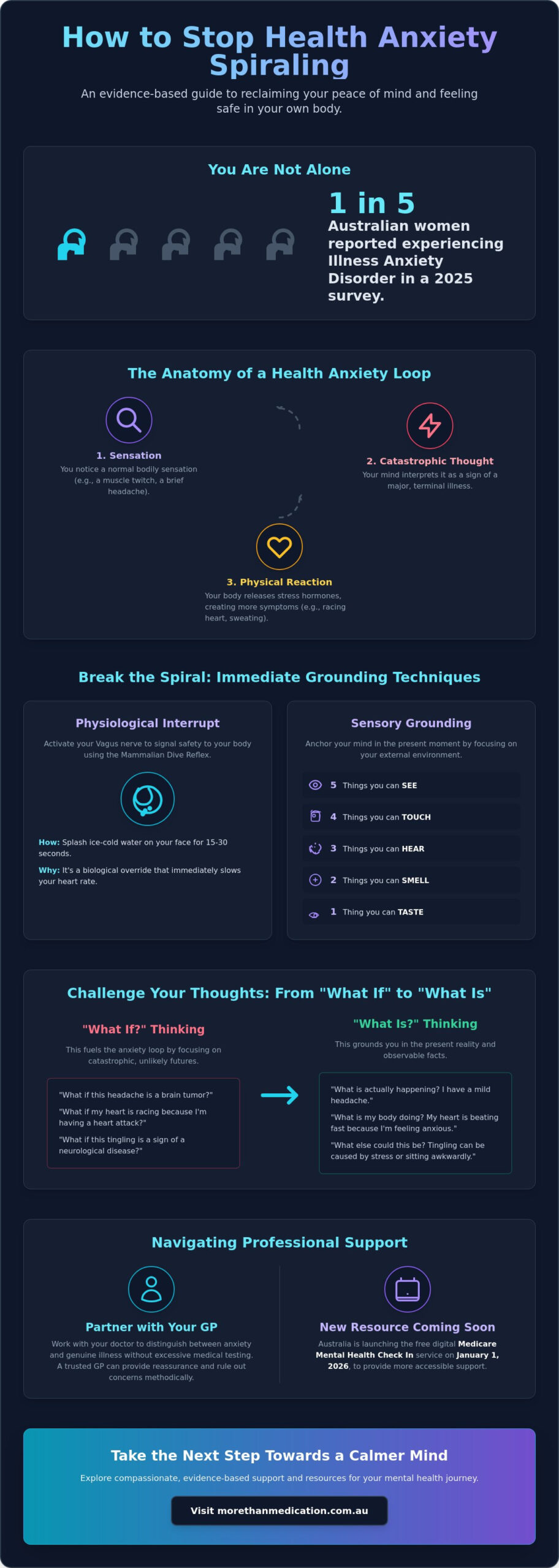
In a 2025 survey, 20% of Australian women reported experiencing illness anxiety disorder, proving that if you’re currently searching for how to stop health anxiety spiraling, you’re far from alone. It’s incredibly isolating when your heart races or your hands tingle, and everyone tells you it’s “just stress” while your mind insists it’s something much worse. You feel like a prisoner in your own body, caught in a loop where every physical sensation feels like a fresh alarm bell.
We’re here to provide a compassionate, evidence-based roadmap to help you reclaim your peace of mind and feel safe within yourself again. This guide explores immediate grounding techniques to halt a panic spike, a framework for distinguishing anxiety from genuine medical concerns, and ways to access professional support. We’ll also highlight new resources like the free digital Medicare Mental Health Check In service launching on January 1, 2026, to ensure you have the support you need for your journey toward balance and resilience.
Key Takeaways
- Understand the mind-body feedback loop where normal physical sensations are misinterpreted as medical threats.
- Practice immediate grounding techniques that activate your Vagus nerve, providing a practical way for how to stop health anxiety spiraling when panic strikes.
- Transition from catastrophic “what if” thinking to a grounded “what is” perspective using evidence-based cognitive reframing.
- Explore how holistic factors like sleep and nutrition can mimic anxiety symptoms, helping you build a more resilient daily routine.
- Learn how to partner with your GP to distinguish between anxiety and genuine illness without the need for excessive medical testing.
Understanding the Health Anxiety Spiral: Why Your Mind Fixates on Your Body
Feeling a sudden twinge in your chest or a strange tingling in your fingertips can send your thoughts racing. Your brain immediately asks, “What if this is serious?” Within seconds, your heart rate climbs, and the very physical symptoms you’re worried about begin to intensify. This is the essence of a health anxiety spiral. It’s a feedback loop where a physical sensation triggers a mental interpretation, which then creates more physical sensations. It’s exhausting, but it’s actually your brain trying to protect you. Evolutionarily, our ancestors survived because their brains prioritized worst-case scenarios, assuming a rustle in the grass was a predator rather than just the wind. Your brain is simply using that same ancient survival software on your internal “rustles” to keep you safe from perceived threats.
In clinical terms, this persistent worry is often called health anxiety or Illness Anxiety Disorder. It isn’t about “making things up.” The chest tightness, dizziness, or muscle tension you feel is a real physiological response to adrenaline. While a 2025 survey showed that 20% of Australian women reported experiencing this disorder, many still feel misunderstood by those around them. Understanding that your mind is fixating on your body as a safety mechanism is the first step in learning how to stop health anxiety spiraling.
The Anatomy of a Health Anxiety Loop
- Step 1: You notice a normal bodily sensation, like a slight itch, a muscle twitch, or a brief headache.
- Step 2: You assign a catastrophic meaning to it, assuming it’s a sign of a major or terminal illness.
- Step 3: Your body reacts to that fear by releasing stress hormones, creating more physical symptoms like sweating or a racing heart.
Why “Dr. Google” Makes the Spiral Worse
Turning to the internet for answers usually adds fuel to the fire. Search algorithms prioritize high-engagement results, which are often the rarest and scariest medical cases. You might experience confirmation bias, fixating only on the worst-case scenario while ignoring common explanations. While searching offers temporary relief, it fuels long-term fear by keeping your brain on high alert. Identifying these triggers is essential for anyone wanting to know how to stop health anxiety spiraling before it takes over their day.
Immediate Grounding Techniques to Break a Physical Spiral
When your heart starts pounding, logic often fails. You can’t simply think your way out of a panic spike because your nervous system has already hit the alarm. To learn how to stop health anxiety spiraling, you must first address the physical “fire” before trying to reason with the “smoke.” This process involves physiological interruption. By stimulating the Vagus nerve, which runs from your brain to your abdomen, you signal to your body that it’s time to switch from “fight or flight” to “rest and digest.” One of the fastest ways to achieve this is the Mammalian Dive Reflex. Splashing ice-cold water on your face for 15 seconds triggers an immediate drop in heart rate. It’s a primitive biological override that forces your system to settle.
Health anxiety can make you feel like a spectator in your own body, but these tools help you grab the steering wheel. Remember, these techniques are for managing the intense symptoms of the moment. They aren’t a permanent cure for the underlying worry; they provide the mental space needed to take the next step in your wellness journey. For more insights on maintaining this balance, you can explore our latest expert advice on mental health. Whether you’re at home or in a busy office, having a toolkit of physical resets is essential for regaining control.
Sensory Grounding: The 5-4-3-2-1 Method
This method pulls your focus away from internal catastrophic thoughts and anchors you in the present environment. It’s a discreet way to manage a spiral in public. Follow these steps slowly:
- 5 things you see: Look for small details, like a blue pen or a pattern on the wall.
- 4 things you can touch: Feel the texture of your shirt or the cold surface of a desk.
- 3 things you hear: Listen for distant traffic, a ticking clock, or a humming fridge.
- 2 things you smell: Notice the scent of your coffee or even just the air around you.
- 1 thing you taste: Focus on the lingering taste of a mint or a sip of water.
Focusing on these external details forces your brain to process neutral data, which effectively interrupts the fear cycle.
Breathwork for Physiological Safety
Box breathing is a favorite among emergency responders for a reason. Inhale for 4 seconds, hold for 4, exhale for 4, and hold for 4. If you need something even faster, try the “Physiological Sigh.” Take two quick inhales through the nose; the second one should be a short “top-up” to fully expand the lungs. Follow this with one long, slow exhale through the mouth. Lengthening the exhale is the specific trigger that tells your brain the danger has passed. It’s a simple, evidence-based strategy for anyone wondering how to stop health anxiety spiraling when they only have a few seconds to spare.
Challenging the Mental Narrative: From “What If” to “What Is”
Once you have used grounding techniques to settle your physical alarm system, the next step is addressing the noisy thoughts that follow. Your mind is incredibly skilled at creating vivid, frightening stories based on tiny fragments of information. Learning how to stop health anxiety spiraling involves more than just ignoring these thoughts; it requires you to actively retrain your brain to interpret bodily data with more balance. You aren’t trying to force “positive thinking” on yourself. Instead, you are looking for “accurate thinking” that accounts for all the facts, not just the scary ones.
A major hurdle in this process is the persistent fear that if you stop worrying, you might miss a genuine medical emergency. It is a protective instinct that feels like a shield, but constant hyper-vigilance doesn’t actually keep you safer; it only keeps you exhausted. Catastrophising is the mental habit of jumping to the worst possible conclusion without evidence. To break this habit, you need to distinguish between productive and unproductive worry. Productive worry leads to a single, clear action, such as booking a skin check you’ve delayed. Unproductive worry is a circular loop that provides no new information and only serves to increase your distress.
The “Balanced Thought” Framework
When a frightening thought appears, try to view it as a hypothesis rather than a fact. If you feel a sharp pain in your head and immediately think, “This is a brain tumour,” stop and look for alternative evidence. Have you been staring at a screen for eight hours today? Did you skip lunch or forget to drink water? A balanced middle ground might sound like this: “It is far more likely that I have a tension headache from my desk work, but I will monitor it calmly while I rest.” This approach acknowledges the sensation without letting the narrative run wild.
Setting Boundaries for Body Checking
Breaking the spiral also means changing the physical habits that keep your brain in a state of high alert. Constant “body checking,” such as pressing on glands or staring at your throat in the mirror, sends a signal to your brain that you are in danger. Try implementing these three boundaries to regain your sense of peace:
- The 48-Hour Rule: Unless it is a clear emergency, give minor symptoms 48 hours to resolve on their own before you seek medical advice or search for answers.
- Limit Reassurance Seeking: Avoid asking loved ones “Does this look normal?” because the relief you feel is temporary and eventually makes the anxiety return with more intensity.
- The 30-Second Window: If you must check a symptom, limit yourself to one 30-second window per day. This prevents the checking from becoming a ritual that consumes your afternoon.
By setting these gentle limits, you teach your nervous system that it doesn’t need to be on guard every second of the day. This is a vital part of the journey toward feeling safe and balanced within your own skin.
The Holistic Approach: Building Resilience Beyond the Spiral
While grounding techniques help in the heat of the moment, long-term peace comes from creating a body that feels like a safe home. This aligns with the More Than Medication philosophy, which recognizes that health is about the whole person rather than just a symptom list. When you focus on lifestyle, you give your brain consistent evidence that you are well. This is a foundational step in learning how to stop health anxiety spiraling before it even begins. By addressing the physical environment of your nervous system, you reduce the number of “false alarms” your brain receives.
Sleep deprivation is a major trigger that often goes overlooked. If you’ve had less than six hours of rest, your nervous system is naturally more reactive; every twinge feels magnified. Similarly, caffeine is a potent stimulant that mimics the physical symptoms of a panic attack, such as a racing heart or jittery hands. If you’re already prone to health-related worry, that extra espresso might be the catalyst for a spiral. Incorporating regular movement into your week is about more than just physical fitness. Exercise helps your body process the excess cortisol and adrenaline that accumulate when you’re stressed. It teaches your brain that a high heart rate can be a sign of health and strength, not just a sign of danger.
Nutrition and Nervous System Regulation
What you eat directly impacts how your brain interprets physical sensations. A sharp drop in blood sugar can cause dizziness, shakiness, and irritability, which are easily mistaken for medical emergencies. Staying hydrated is equally vital. Even mild dehydration can lead to brain fog and palpitations. Reducing stimulants like caffeine and nicotine can significantly lower your baseline anxiety, making it easier to stay calm when a stray sensation occurs. For more personalized support on your journey, you can explore our expert advice on living a balanced lifestyle.
Mindfulness as a Long-term Tool
Mindfulness isn’t about clearing your mind. It’s about changing your relationship with your thoughts. Instead of judging a sensation as “bad” or “scary,” you learn to observe it like a neutral witness. The “Leaves on a Stream” meditation is particularly helpful for intrusive health thoughts. You imagine each worry as a leaf floating down a river. You acknowledge it’s there, but you don’t jump into the water to grab it. This practice builds the mental muscle needed to stay in the present moment rather than drifting into a catastrophic future.
Navigating Support: Professional Help and the Australian Healthcare System
Self-help strategies are powerful tools, but there comes a point in your journey where partnering with a professional is the most compassionate choice you can make for yourself. If your worries interfere with your ability to work, sleep, or enjoy relationships despite your best efforts, it’s time to seek external support. Learning how to stop health anxiety spiraling often requires a team approach. In Australia, your General Practitioner is the gateway to this support. A trusted “Home GP” who understands your history can provide the continuity of care needed to manage health concerns without falling into the trap of over-testing, which often fuels more anxiety.
When you visit your doctor, be open about your struggle with health-related worry. You can ask for “evidence-based reassurance,” which involves your doctor explaining why they aren’t concerned based on your physical clinical signs. This is different from simply asking for more tests. Under the MyMedicare program, having a registered practice ensures you can access consistent care. As of November 2025, remember that to access Medicare-rebatable telehealth services for mental health, you must have had at least one face-to-face appointment with your practitioner in the last 12 months. This personal connection helps your doctor distinguish between a new physical symptom and a manifestation of your anxiety.
Talking to Your Doctor About Health Anxiety
Honesty is your best asset during a check-up. Tell your GP, “I am experiencing physical symptoms, but I am also struggling with intense anxiety about what they mean.” This allows them to treat you as a whole person. They can help you create a Mental Health Treatment Plan, which is a formal document that opens up access to subsidized therapy. By addressing the mental and physical aspects of your wellbeing together, you move closer to a balanced lifestyle that isn’t dictated by fear.
Accessing Therapy and Community Support
Therapy is the gold standard for long-term resilience. Cognitive Behavioural Therapy (CBT) specifically helps you dismantle the “what if” loops we discussed earlier. With a Mental Health Treatment Plan, you can access up to 10 individual sessions per calendar year. As of January 4, 2026, the Medicare rebate is $98.97 per session with a general psychologist and $145.25 for a clinical psychologist. These rebates help bridge the gap between the professional fee and your out-of-pocket costs.
For immediate support when a spiral feels too big to handle alone, several Australian organizations offer 24/7 assistance:
- Beyond Blue: Provides support for anxiety and depression via phone or webchat.
- Lifeline: Offers crisis support and suicide prevention services.
- Medicare Mental Health Check In: A free digital service launched on January 1, 2026, offering self-help tools and professional access without a GP referral for those over 16.
Utilizing these resources is a proactive way to manage your health. It reinforces the idea that you don’t have to carry the weight of your worries by yourself. Professional guidance provides the external perspective needed to finally understand how to stop health anxiety spiraling and stay grounded in your daily life.
Your Journey Toward a Calmer, More Balanced Life
Learning how to stop health anxiety spiraling is a journey that begins with a single, compassionate step toward yourself. You’ve discovered how to interrupt physical panic using the Vagus nerve and sensory grounding, while also learning to challenge catastrophic thinking with a balanced perspective. It’s important to remember that you aren’t alone. A 2025 survey revealed that 20% of Australian women share this experience. Whether you’re implementing the 48-hour rule for symptoms or preparing to use the free Medicare Mental Health Check In service starting January 1, 2026, every choice you make strengthens your resilience.
We’re dedicated to helping you navigate the intersection of mental and physical wellbeing with expert-led mental health insights and a holistic wellness focus. Our platform is built on proudly supporting the Australian health journey through every peak and valley. Discover more expert advice on living a balanced lifestyle at More Than Medication. You deserve to feel safe and steady within your own body. With the right tools and support, that sense of peace is well within your reach.
Frequently Asked Questions
How can I tell the difference between anxiety and a real medical issue?
Anxiety symptoms often shift, change, or even disappear when you’re deeply distracted by a task or a conversation. In contrast, symptoms of a physical illness usually persist or worsen regardless of your mental focus. If you’re unsure, apply the 48-hour rule for minor concerns; however, always seek immediate emergency care for red-flag symptoms like sudden chest pain, difficulty breathing, or loss of consciousness.
Why does my body feel real pain when the doctor says I am healthy?
Your brain and nervous system can create genuine physical pain through a process called somatization, where emotional distress manifests as bodily sensations. When you’re in a state of high alert, your brain amplifies signals from your nerves, causing real muscle tension, sharp pains, or digestive upset. This pain isn’t “made up”; it’s a physiological reality of a nervous system that’s stuck in a survival loop.
How long does an anxiety spiral usually last?
A physical panic spike typically peaks within 10 to 30 minutes, but the mental “looping” or “anxiety hangover” can last for several hours or even days if left unmanaged. Learning how to stop health anxiety spiraling through grounding and breathwork can significantly shorten this duration. The intensity usually begins to fade once you stop the cycle of body checking and searching for reassurance.
Is health anxiety a form of Obsessive-Compulsive Disorder (OCD)?
Health anxiety shares several characteristics with OCD, such as intrusive thoughts and repetitive checking behaviors, but it’s officially classified as Illness Anxiety Disorder. Both conditions involve a difficult relationship with uncertainty and a need for absolute “proof” of safety. Treatment for both often centers on Cognitive Behavioural Therapy to help break the cycle of seeking temporary relief through compulsions.
What should I do if my doctor dismisses my concerns as “just anxiety”?
You can ask your doctor for a collaborative approach that acknowledges your physical symptoms while also addressing the underlying worry. If you feel unheard, it’s perfectly okay to seek a second opinion from a GP who has a specific interest in mental health. Having a doctor who validates that your physical symptoms are real, even if they’re caused by stress, is vital for your recovery.
Can I ever fully recover from health anxiety?
Yes, many people achieve long-term recovery where health worries no longer dictate their daily choices or emotional state. Recovery doesn’t always mean never having a “what if” thought again; it means building the resilience to process those thoughts without falling into a spiral. In a 2025 survey, patients who combined professional therapy with lifestyle changes reported a significant improvement in their quality of life.
How do I stop myself from Googling symptoms when I feel a twinge?
Create a physical barrier by using website blockers or moving medical apps into a hidden folder on your phone. When the urge to search hits, write the symptom down in a “worry diary” and commit to waiting 48 hours before looking it up. This delay gives your rational brain time to catch up with your emotional brain, often making the urge to search disappear entirely.
What is a Mental Health Care Plan and how do I get one in Australia?
A Mental Health Treatment Plan is a document created by your GP that provides you with Medicare rebates for up to 10 psychological sessions per calendar year. To get one, you’ll need to book a long consultation with your GP specifically to discuss your mental health. This plan is the primary pathway in the Australian healthcare system for accessing subsidized, professional support from psychologists or social workers.
⚕️ Medical Disclaimer
This content is for informational purposes only and is not a substitute for professional medical advice, diagnosis, or treatment. Always seek the advice of your doctor or other qualified health provider with any questions you may have regarding a medical condition. Never disregard professional medical advice or delay in seeking it because of something you have read on this website.