
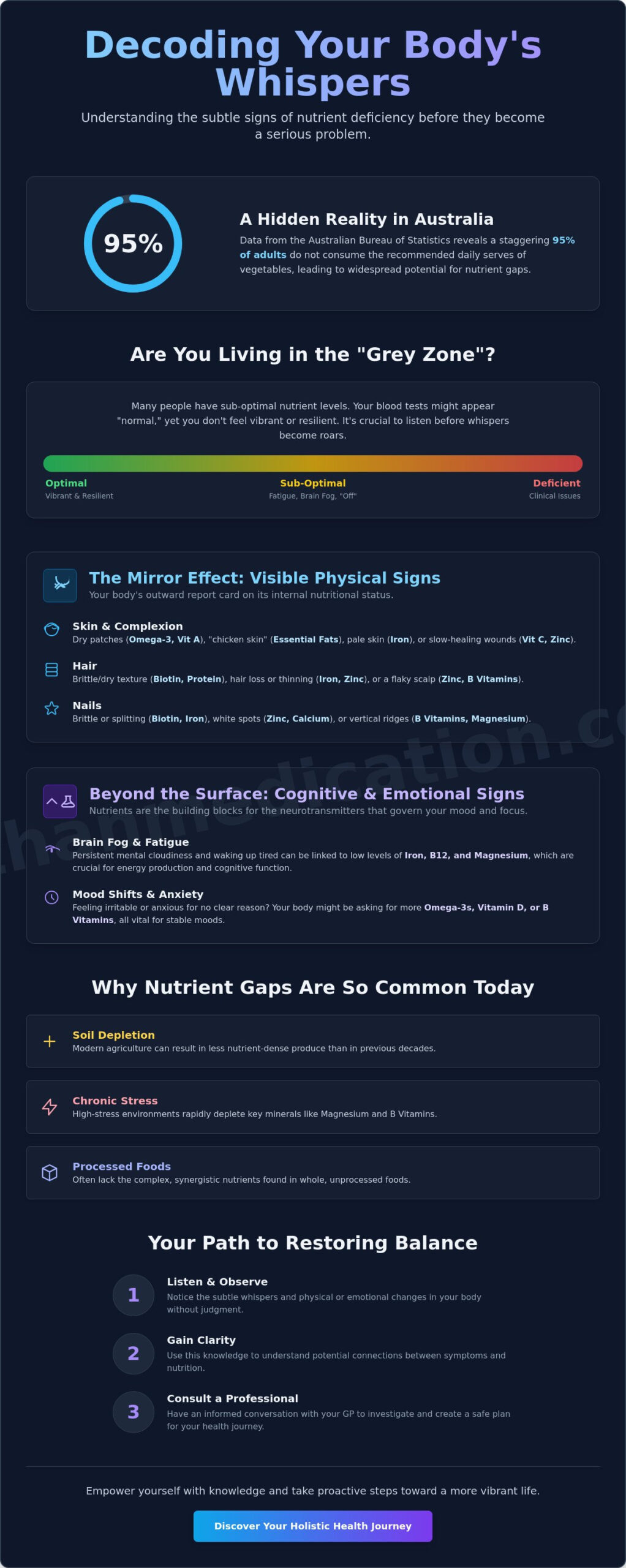
What if that nagging afternoon brain fog isn’t just a sign of a long day, but your body’s way of asking for a specific mineral? You’ve likely felt the frustration of waking up tired even after a full night’s rest or felt overwhelmed by the endless stream of conflicting nutrition advice on social media. It’s common to feel anxious when your health doesn’t quite align with your efforts, but identifying the signs of nutrient deficiency is the first step toward reclaiming your energy. Data from the Australian Bureau of Statistics shows that 95% of adults don’t eat the recommended daily serves of vegetables, meaning these nutritional whispers are a reality for many of us.
We’re here to help you understand that your wellbeing is about more than just a checklist of vitamins; it’s about the deep connection between your mind and body. You’ll discover how to recognise the subtle physical and emotional cues your system sends when it’s out of balance. By the end of this article, you’ll feel empowered to have an informed conversation with your GP and take proactive, manageable steps toward a more vibrant life. We’ll look at everything from skin changes to mood shifts, ensuring you have the tools to handle your health journey with confidence and clarity.
Key Takeaways
- Learn to listen to your body’s “whispers” by distinguishing between sub-optimal nutrient levels and clinical deficiencies before they impact your long-term wellbeing.
- Discover how to read the “mirror effect,” where subtle changes in your skin, hair, and nails serve as the first outward signals of internal nutritional gaps.
- Identify the common emotional and cognitive signs of nutrient deficiency, such as brain fog or mood shifts, that are often mistakenly dismissed as everyday stress.
- Understand the “Australian Paradox” and why our sun-drenched lifestyle doesn’t always guarantee adequate Vitamin D and other essential nutrients according to local standards.
- Gain a clear framework for transitioning from self-observation to a meaningful partnership with healthcare professionals to safely restore your body’s natural balance.
What Are the Signs of Nutrient Deficiency and Why Do They Matter?
Have you ever felt just slightly out of sync? It isn’t always a full-blown illness that stops you in your tracks, but rather a nagging fatigue, a persistent brain fog, or a brittle quality to your hair. These sensations aren’t failures of your will or signs that you’re simply “getting older.” They’re often the first whispers from your body, asking for a little more support. Understanding the early signs of nutrient deficiency is about learning to listen to these subtle signals before they escalate into more serious health challenges.
There’s a vital difference between a clinical deficiency and sub-optimal nutrient levels. A clinical deficiency is the point where a lack of a specific vitamin or mineral causes a named disease, such as scurvy or rickets. However, many Australians live in a “grey zone” of sub-optimal levels. In this space, your blood tests might appear within the broad “normal” range, yet you don’t feel vibrant or resilient. It’s an exhausting place to be, especially when you’re trying to keep up with the demands of a busy life. We believe that health is a continuous journey of discovery. Real wellbeing is always more than medication; it’s a holistic process of nourishing every part of yourself.
The Body-Mind Connection in Nutrition
Your body uses nutrients as the fundamental building blocks for everything from the physical structure of your bones to the delicate neurotransmitters that govern your mood and sleep. When you experience a symptom, it’s helpful to view it as a communication from your system rather than an inconvenience to be silenced. A Micronutrient deficiency can disrupt the intricate chemistry that keeps you feeling balanced and focused. A micronutrient is the essential spark for cellular energy that powers every single function in your body.
Why Modern Lifestyles Lead to Gaps
Even if you’re diligent about your diet, the modern world presents unique challenges to our nutritional status. Soil depletion in many agricultural areas means that the produce on our shelves may not be as nutrient-dense as it was several decades ago. Additionally, the high-stress environments of 2026 cause the body to rapidly deplete certain minerals like magnesium and B vitamins. Processed foods, even those marketed as healthy, often lack the complex synergetic compounds found in whole foods.
It’s becoming clear that a “standard” healthy diet might still leave you with hidden gaps. Staying informed about The Latest Health Trends in 2026 is a great way to understand how environmental changes impact our needs. By recognizing the signs of nutrient deficiency early, you can take small, manageable steps toward reclaiming your energy. This proactive approach turns a health struggle into an opportunity for empowerment and long-term resilience.
The Mirror Effect: Visible Physical Signs of Nutrient Gaps
Your body is a master of prioritisation. When resources run low, it funnels vitamins and minerals toward vital organs like your heart and liver. Your skin, hair, and nails often wait at the back of the line. It’s frustrating to look in the mirror and see dullness or brittle textures, but these are actually helpful messengers. They’re early signs of nutrient deficiency that allow you to act before deeper health issues arise. This outward reporting system isn’t a critique of your appearance; it’s a gentle nudge to look closer at your internal balance.
Take a moment for a non-judgmental self-assessment. Notice the textures and colours that might have shifted lately. This process is about curiosity, not criticism. You’re learning to interpret the language your body speaks when it needs a little extra care on your holistic health journey.
Skin and Complexion Signals
Dry, scaly patches that don’t respond to your usual moisturiser often signal a need for Omega-3 fatty acids or Vitamin A. These nutrients maintain the skin’s moisture barrier. If you notice “chicken skin” or small, painless bumps on the back of your arms, your body might be asking for more essential fats. This condition, known as keratosis pilaris, affects roughly 40 percent of adults globally and is a common indicator of fatty acid gaps.
Slow wound healing or easy bruising can be linked to Vitamin C or K shortages. Vitamin C is essential for collagen production; without it, your skin loses its structural integrity. Understanding the truth about nutrient deficiencies helps you see these changes as data points rather than flaws. When you address the root cause, you’re supporting your body’s largest organ from the inside out.
Hair and Nail Health
Brittle hair that thins or breaks easily is often tied to Biotin (B7) or Iron levels. In Australia, Iron deficiency remains the most common nutritional gap, affecting approximately 12 percent of the population. If your hair has lost its lustre or feels like straw, it’s a sign that your follicles are being deprioritised in favour of more critical metabolic functions.
- White spots: Small white flecks on the nails, often called Leukonychia, frequently indicate a Zinc deficiency rather than a calcium gap as commonly believed.
- Ridges: Vertical ridges can be a natural part of ageing, but deep horizontal grooves may suggest a protein or Zinc shortage.
- Mouth warnings: Painful mouth ulcers or cracks at the corners of your lips, known as angular cheilitis, are classic signs of nutrient deficiency related to B-vitamins, specifically B2, B6, and B12.
These visible cues provide a map for your recovery. By responding to these subtle shifts now, you can restore your energy and resilience before the gaps widen. It’s about finding a steady pace toward wellness that respects both your physical and emotional needs.
Beyond the Surface: Cognitive and Emotional Signs of Deficiency
When you feel irritable or find your mind wandering during a work meeting, it’s easy to blame a busy schedule. You might tell yourself you’re just stressed or didn’t sleep well. However, your mental state is often a direct reflection of your internal chemistry. Recognising the cognitive signs of vitamin and mineral deficiencies can be the first step toward reclaiming your sense of self. Your brain requires a constant supply of specific nutrients to maintain its resilience and keep your mood steady. These “unseen” symptoms are just as valid as physical pain. They deserve your attention and a compassionate response as you look for ways to restore your inner balance.
Brain Fog and Cognitive Fatigue
Feeling like you’re thinking through a thick mist isn’t just a sign of a long day. Brain fog is often the brain’s way of ‘conserving energy’ during nutrient scarcity. When your Vitamin B12 or Iron levels drop, your blood struggles to deliver enough oxygen to your brain cells, leading to that heavy, sluggish feeling. Data from the Australian Bureau of Statistics indicates that nearly 1 in 4 Australians don’t consume enough Vitamin B12 through their diet alone. Iodine also plays a critical role here. It fuels your thyroid, which acts as a master controller for your metabolism and mental sharpness. Without these foundations, your cognitive battery drains faster than it can recharge. This isn’t a personal failing; it’s a physiological signal that your internal environment needs a little extra care to regain its clarity.
Mood Swings and Emotional Resilience
Emotional wellbeing is deeply rooted in your nutritional foundation. If you find your patience wearing thin or your mood dipping without a clear reason, your body might be calling for Magnesium or Vitamin D. These nutrients are essential for serotonin production, the chemical that helps you feel balanced and calm. Magnesium, in particular, acts as a natural relaxant for your nervous system, helping you stay grounded when life feels overwhelming. Omega-3 fatty acids are equally vital, as they provide the structural integrity your brain cells need to communicate effectively.
It’s about more than just a chemical balance; it’s about the emotional toll of feeling chronically depleted. We understand that health is a journey, and supporting your nervous system with the right nutrients helps you navigate the highs and lows with greater ease. Identifying these signs of nutrient deficiency allows you to move from a place of frustration to one of empowerment. By listening to these subtle emotional shifts, you can take small, actionable steps toward feeling like yourself again, ensuring your mental health is supported by a strong physical base.
Common Nutrient Gaps for the Australian Lifestyle
Living in Australia brings unique health challenges that often go unnoticed. While we enjoy a lifestyle centered around the outdoors, our bodies don’t always reflect the abundance of our environment. The National Health and Medical Research Council (NHMRC) sets rigorous standards for nutrient intake, yet many of us fall short of these benchmarks. We often see what experts call the “Australian Paradox.” Despite our sun-drenched coastlines, approximately 23% of Australian adults live with a Vitamin D deficiency. This isn’t just a statistic; it’s a reflection of how our modern, sun-safe, and indoor-focused habits clash with our biological needs. Identifying the signs of nutrient deficiency helps you bridge the gap between your current state and true vitality.
The Vitamin D and Magnesium Balance
You might wonder why you feel sluggish despite a weekend spent outdoors. Sunscreen and protective clothing are vital for skin health in our climate, but they also limit your body’s ability to naturally synthesize Vitamin D. This often works in tandem with Magnesium. If you’re physically active, your demand for Magnesium increases significantly. It’s essential for muscle recovery and maintaining a calm nervous system. When these levels drop, you might experience restless legs or poor sleep quality. Supporting your body through movement is a key part of this journey. You can explore how physical activity influences your nutritional needs in our Fitness for Life guide.
Iron and B12: The Energy Duo
Feeling “tired but wired” is a common struggle for many Australians. This state of exhaustion coupled with an inability to settle often points toward Iron or B12 gaps. Iron deficiency is particularly prevalent among active women and those following plant-based or flexitarian diets. In fact, data suggests that about one in eight Australians don’t consume enough iron to meet their daily requirements. If you’ve swapped traditional proteins for plant-based alternatives, you need to be more intentional about your intake. Incorporating nutrient-dense snacks is a practical way to boost these levels throughout your day. Try some of our Healthy Slice Recipes to make nourishment feel like a treat rather than a chore.
The Impact of Australian Soil
Our health is deeply connected to the land, but our geography has its limits. Australian soil is naturally low in Iodine and Selenium. These minerals are crucial for thyroid function and protecting your cells from stress. Because our produce grows in this mineral-poor earth, even a diet rich in vegetables might leave you lacking. Recognizing the signs of nutrient deficiency, such as unexplained weight changes or brittle hair, can be your body’s way of asking for these specific trace minerals. It’s a reminder that health is always about the whole person and the environment we inhabit.
Navigating Your Journey: From Identifying Signs to Restoring Balance
Recognising the signs of nutrient deficiency is a brave first step toward reclaiming your vitality. It is the moment you stop pushing through the fatigue and start listening to what your body truly needs. While identifying these signals is empowering, you don’t have to navigate the path to recovery alone. True healing happens when you combine your personal intuition with professional clinical guidance, ensuring your journey is both safe and effective.
How to Talk to Your GP
Walking into a medical appointment with a clear plan can reduce anxiety and lead to better health outcomes. We recommend keeping a “symptom and energy” diary for 14 days before your visit. Record your sleep quality, daily energy levels on a scale of 1 to 10, and any physical changes like brittle nails or restless legs. This data provides your doctor with a map of your experience that goes beyond a single moment in time.
During your consultation, be specific about your concerns. You can request a comprehensive blood panel to look for common gaps. In Australia, this typically includes:
- Full Blood Count (FBC): To check overall health and oxygen-carrying capacity.
- Iron Studies: Including ferritin levels to assess your long-term stores.
- Vitamin B12 and Folate: Essential for nerve function and energy.
- Vitamin D: Vital for bone health and immune support, especially if you spend most of your time indoors.
If your results return within the “normal” range but you still feel sub-clinically unwell, don’t be afraid to ask more questions. You are the expert on your own lived experience, and your GP is there to partner with you in finding a state of wellness that feels right for you.
Small Steps for Big Impact
Taking action when you notice the signs of nutrient deficiency doesn’t require an overnight overhaul of your entire life. We advocate for a “Food First” philosophy, which focuses on “crowding in” rather than cutting out. Instead of focusing on restriction, try adding one nutrient-dense food to every meal. A handful of baby spinach in your morning eggs or a tablespoon of pumpkin seeds on your salad can significantly boost your mineral intake without the stress of a rigid diet.
How you eat is just as important as what you eat. Practising mindful eating helps shift your nervous system into the “rest and digest” state, which is essential for optimal nutrient absorption. Simply taking three deep breaths before you start your meal can signal to your body that it’s safe to process and use the vitamins you’re consuming. While supplements are sometimes a necessary bridge to restore balance quickly, using a tailored approach like Zenutri Personalised Vitamins ensures your body receives exactly what it needs, working best when supported by these gentle, sustainable lifestyle shifts. Your body possesses an incredible capacity for resilience and renewal when you provide the right environment and nourishment.
Taking the Next Step Toward Lasting Vitality
Your body constantly communicates its needs through subtle shifts in your energy, mood, and appearance. Recognizing these signs of nutrient deficiency allows you to move beyond simply treating symptoms to addressing the root cause of your wellbeing. Data from the Australian Bureau of Statistics shows that over 93% of Australian adults struggle to meet daily vegetable intake targets, which highlights how easily nutritional gaps can form in our busy lives. By paying attention to these physical and emotional markers, you’re not just managing a diet; you’re nurturing a resilient foundation for your future.
We believe health is a deeply personal journey where medicine is only one piece of the puzzle. Our expert-led content focuses on holistic wellbeing, providing you with empathetic, jargon-free health education that feels like a conversation with a trusted friend. We analyze Australian-centric health trends to ensure you have the most relevant information for your unique lifestyle. There’s always more to your wellness than a diagnosis, and you don’t have to navigate these changes alone. For more expert advice on living a balanced lifestyle, explore our latest wellness guides. You have the power to restore your balance, and we’re here to support you every step of the way.
Frequently Asked Questions
Can I have a nutrient deficiency even if I eat a healthy diet?
Yes, you can still experience signs of nutrient deficiency despite eating a balanced diet. Factors like soil depletion, age, or how your body absorbs nutrients play a significant role in your wellbeing. For instance, the Australian Bureau of Statistics (ABS) reports that 73% of Australian women don’t meet the estimated average requirement for calcium. It’s about how your body processes what’s on your plate, not just the food itself. This journey toward balance requires looking deeper than your daily menu.
How long does it take to see improvements after addressing a deficiency?
You’ll typically start to feel subtle shifts in 3 to 6 weeks, but physiological changes often take longer to manifest. It takes about 120 days for your body to produce new red blood cells, which is why doctors usually suggest re-testing after 3 months. Your path to resilience isn’t an overnight fix. It’s a steady process of replenishing your stores. Be patient with your body as it heals and finds its natural rhythm again.
Is it safe to start taking a multivitamin if I suspect a deficiency?
While multivitamins are generally safe for most Australians, it’s best to consult a professional before starting any new regimen. High doses of fat-soluble vitamins like Vitamin A can build up in your system over time. The Therapeutic Goods Administration (TGA) monitors these supplements for safety, but they aren’t a substitute for a targeted plan. Identifying your specific needs ensures you’re giving your body exactly what it requires for true empowerment and physical balance.
What are the most common signs of iron deficiency in adults?
Persistent exhaustion and brittle nails are primary indicators that your iron levels might be low. You might also notice your skin looks paler than usual or feel breathless after walking up a single flight of stairs. Statistics from the Australian Red Cross Lifeblood show that 1 in 8 Australians will experience iron deficiency at some point. Recognizing these signs of nutrient deficiency early helps you reclaim your energy and return to the activities you love.
Can a lack of vitamins cause anxiety or low mood?
Yes, your mental wellbeing is closely tied to your nutritional status. Low levels of B12 or Vitamin D can disrupt neurotransmitter production, leading to feelings of low mood or heightened anxiety. Research suggests that people with low B12 levels have a 25% higher risk of experiencing severe depression. It’s a powerful reminder that health is holistic. Supporting your physical body is a vital step in nurturing your emotional resilience and finding inner calm.
How often should I get my nutrient levels checked by a doctor?
Scheduling a blood test once every 12 months is a proactive way to monitor your health journey. If you’re managing a chronic condition or have recently changed your diet, your GP might recommend checking every 6 months. These regular check-ins provide a clear map of your progress. They transform guesswork into a manageable, evidence-based plan for your long-term vitality. It’s a small step that offers significant peace of mind for your future.
Are there specific signs of vitamin D deficiency I should look for?
Aching bones and frequent colds are classic signals that your Vitamin D levels might be low. You may also experience muscle weakness that makes daily tasks feel much heavier. Data from the Australian Bureau of Statistics shows that 23% of Australian adults have a clinical Vitamin D deficiency. Since your body is more than just its symptoms, addressing this lack can improve both your bone health and your immune system’s natural strength.
Can poor gut health lead to nutrient deficiencies even if I eat well?
Yes, your gut is the gateway to your health, and inflammation can prevent effective nutrient absorption. Conditions like celiac disease, which affects 1 in 70 Australians, can cause significant deficiencies regardless of how healthy your meals are. If your digestive system isn’t functioning optimally, your body can’t access the fuel it needs. Focusing on gut health is a foundational part of your holistic journey toward feeling your absolute best every single day.
⚕️ Medical Disclaimer
This content is for informational purposes only and is not a substitute for professional medical advice, diagnosis, or treatment. Always seek the advice of your doctor or other qualified health provider with any questions you may have regarding a medical condition. Never disregard professional medical advice or delay in seeking it because of something you have read on this website.